
Ceres作为一个优化算法库,在许多领域中有着至关重要的作用,比如slam系统中的优化问题-集束调整BA,就可以通过Ceres去实现,官方文档地址:http://ceres-solver.org/nnls_tutorial.html#bundle-adjustment
本文主要是解析ceres中的LM算法过程,参考代码地址:
https://github.com/ceres-solver/ceres-solver/tree/master/internal/ceres
一、主要流程
先贴个图,LM算法的大概流程如下
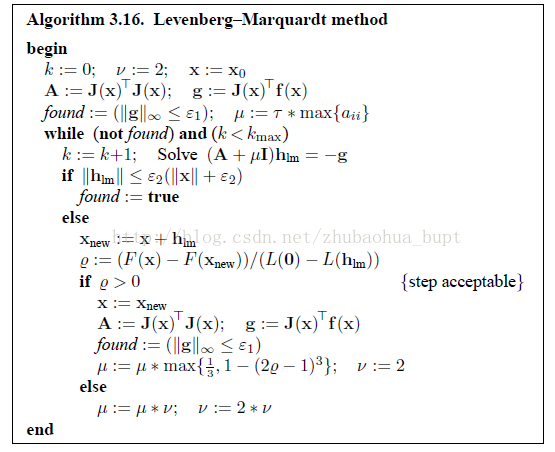

可以看到,LM算法的输入为(1)雅可比矩阵J(x);(2)残差向量f(x);(3)待优化变量初值x0;(4)控制参数等
LM算法要求解的问题为:
其中为残差函数,它的导函数为,二阶导函数的近似为
分为几个步骤:
(1)初始化:首先计算系数矩阵A和残差向量g,初始化参数
(2)while循环:如果达到收敛条件就停止迭代
(3)求解 (A+miu*I)dx = -g
(4) xnew = x+dx
(5) ,其中Fx,Fxnew是所有残差的平方和
(6)如果第五步结果大于零,表示这个迭代是有效的,可以接受
然后更新x = xnew;Fx =Fnew ,A = J’*J, g = J’*f
(7)否则这个dx得到的结果是无效的,收缩搜索半径,相当于增大
ceres对应代码:https://github.com/ceres-solver/ceres-solver/blob/master/internal/ceres/trust_region_minimizer.cc
void TrustRegionMinimizer::Minimize(const Minimizer::Options& options,
                                    double* parameters,
                                    Solver::Summary* solver_summary) {
  start_time_in_secs_ = WallTimeInSeconds();
  iteration_start_time_in_secs_ = start_time_in_secs_;
//初始化
  Init(options, parameters, solver_summary);
//得到初始的雅可比矩阵以及残差矩阵
  RETURN_IF_ERROR_AND_LOG(IterationZero());

  // Create the TrustRegionStepEvaluator. The construction needs to be
  // delayed to this point because we need the cost for the starting
  // point to initialize the step evaluator.
  step_evaluator_.reset(new TrustRegionStepEvaluator(
      x_cost_,
      options_.use_nonmonotonic_steps
          ? options_.max_consecutive_nonmonotonic_steps
          : 0));
//while循环:是否达到迭代终止条件
  while (FinalizeIterationAndCheckIfMinimizerCanContinue()) {
    iteration_start_time_in_secs_ = WallTimeInSeconds();
    iteration_summary_ = IterationSummary();
    iteration_summary_.iteration =
        solver_summary->iterations.back().iteration + 1;
//计算(J'*J+D'*D/radius)*dx = -J'*f
    RETURN_IF_ERROR_AND_LOG(ComputeTrustRegionStep());
    if (!iteration_summary_.step_is_valid) {
//如果当前迭代不是有效的,则收缩搜索半径
      RETURN_IF_ERROR_AND_LOG(HandleInvalidStep());
      continue;
    }

    if (options_.is_constrained &&
        options_.max_num_line_search_step_size_iterations > 0) {
      // Use a projected line search to enforce the bounds constraints
      // and improve the quality of the step.
      DoLineSearch(x_, gradient_, x_cost_, &delta_);
    }
//计算Xnew = x+dx
    ComputeCandidatePointAndEvaluateCost();
    DoInnerIterationsIfNeeded();
//是否||dx||太小了,太小了直接终止
    if (ParameterToleranceReached()) {
      return;
    }
//是否||Fx-Fxnew||太小了,太小了意味着残差平方和更新不动直接终止
    if (FunctionToleranceReached()) {
      return;
    }
//如果是有效的
    if (IsStepSuccessful()) {
//更新x,雅可比矩阵,残差向量等
      RETURN_IF_ERROR_AND_LOG(HandleSuccessfulStep());
      continue;
    }
//否则收缩搜索半径
    HandleUnsuccessfulStep();
  }
}
上面为什么是信赖域算法过程,Ceres里面把LM算法和dogleg算法(也叫狗腿算法)集成到统一的框架下–信赖域算法框架,不同的是LM算法求解dx的过程和狗腿算法不同,下面是LM算法求解dx的过程以及搜索半径的更新
TrustRegionStrategy::Summary LevenbergMarquardtStrategy::ComputeStep(
    const TrustRegionStrategy::PerSolveOptions& per_solve_options,
    SparseMatrix* jacobian,
    const double* residuals,
    double* step) {
  CHECK(jacobian != nullptr);
  CHECK(residuals != nullptr);
  CHECK(step != nullptr);

//计算对角矩阵D
  const int num_parameters = jacobian->num_cols();
  if (!reuse_diagonal_) {
    if (diagonal_.rows() != num_parameters) {
      diagonal_.resize(num_parameters, 1);
    }

    jacobian->SquaredColumnNorm(diagonal_.data());
    for (int i = 0; i < num_parameters; ++i) {
      diagonal_[i] = std::min(std::max(diagonal_[i], min_diagonal_),
                              max_diagonal_);
    }
  }
// D = diag{J'*J}/radius
  lm_diagonal_ = (diagonal_ / radius_).array().sqrt();

  LinearSolver::PerSolveOptions solve_options;
  solve_options.D = lm_diagonal_.data();
  solve_options.q_tolerance = per_solve_options.eta;
  solve_options.r_tolerance = -1.0;
  InvalidateArray(num_parameters, step);
//求解 (A+D'*D)dx = -g
  LinearSolver::Summary linear_solver_summary =
      linear_solver_->Solve(jacobian, residuals, solve_options, step);

  if (linear_solver_summary.termination_type == LINEAR_SOLVER_FATAL_ERROR) {
    LOG(WARNING) << "Linear solver fatal error: "
                 << linear_solver_summary.message;
  } else if (linear_solver_summary.termination_type == LINEAR_SOLVER_FAILURE)  {
    LOG(WARNING) << "Linear solver failure. Failed to compute a step: "
                 << linear_solver_summary.message;
  } else if (!IsArrayValid(num_parameters, step)) {
    LOG(WARNING) << "Linear solver failure. Failed to compute a finite step.";
    linear_solver_summary.termination_type = LINEAR_SOLVER_FAILURE;
  } else {
    VectorRef(step, num_parameters) *= -1.0;
  }
  reuse_diagonal_ = true;

  if (per_solve_options.dump_format_type == CONSOLE ||
      (per_solve_options.dump_format_type != CONSOLE &&
       !per_solve_options.dump_filename_base.empty())) {
    if (!DumpLinearLeastSquaresProblem(per_solve_options.dump_filename_base,
                                       per_solve_options.dump_format_type,
                                       jacobian,
                                       solve_options.D,
                                       residuals,
                                       step,
                                       0)) {
      LOG(ERROR) << "Unable to dump trust region problem."
                 << " Filename base: " << per_solve_options.dump_filename_base;
    }
  }


  TrustRegionStrategy::Summary summary;
  summary.residual_norm = linear_solver_summary.residual_norm;
  summary.num_iterations = linear_solver_summary.num_iterations;
  summary.termination_type = linear_solver_summary.termination_type;
  return summary;
}

//如果当前迭代是有效的,更新搜索半径等参数
void LevenbergMarquardtStrategy::StepAccepted(double step_quality) {
  CHECK_GT(step_quality, 0.0);
  radius_ = radius_ / std::max(1.0 / 3.0,
                               1.0 - pow(2.0 * step_quality - 1.0, 3));
  radius_ = std::min(max_radius_, radius_);
  decrease_factor_ = 2.0;
  reuse_diagonal_ = false;
}

//如果当前迭代是无效的,收缩搜索半径等参数
void LevenbergMarquardtStrategy::StepRejected(double step_quality) {
  radius_ = radius_ / decrease_factor_;
  decrease_factor_ *= 2.0;
  reuse_diagonal_ = true;
}
发布者:全栈程序员-站长,转载请注明出处:https://javaforall.net/187146.html原文链接:https://javaforall.net