
目录
一,问题实例
求解函数 的最大值。
的最大值。
我们可以用python画出图像
from matplotlib import pyplot as plt import numpy as np from mpl_toolkits.mplot3d import Axes3D def func(X, Y, x_move=0, y_move=0): def mul(X, Y, alis=1): return alis * np.exp(-(X * X + Y * Y)) return mul(X, Y) + mul(X - x_move, Y - y_move, 2) def show(X, Y): fig = plt.figure() ax = Axes3D(fig) X, Y = np.meshgrid(X, Y) Z = func(X, Y, 5, 5) plt.title("demo_hill_climbing") ax.plot_surface(X, Y, Z, rstride=1, cstride=1, cmap='rainbow', ) ax.set_xlabel('x label', color='r') ax.set_ylabel('y label', color='g') ax.set_zlabel('z label', color='b') plt.show() if __name__ == '__main__': X = np.arange(-5, 10, 0.1) Y = np.arange(-5, 10, 0.1) show(X,Y)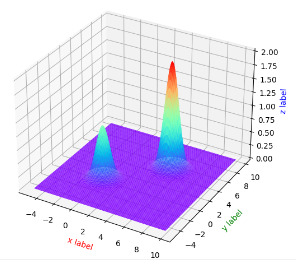
二,暴力求解
求整数级自变量的最大值
double f(double x, double y) { double a = -x * x - y * y; double b = -(x - 5)*(x - 5) - (y - 5)*(y - 5); return exp(a) + 2 * exp(b); } int main() { double ans = 0; for (int i = -5; i <= 10; i++)for (int j = -5; j <= 10; j++) { if (ans < f(i, j)) { ans = f(i, j); cout << i << " " << j << " " << ans<
输出:
即(5,5)附近是第一高峰,(0,0)附近是第二高峰。
算法缺陷:
(1)计算量大,效率低
(2)要想求更精确的值,更加复杂
三,首选爬山算法
首选爬山算法就是每次选择4个邻居,从中选择最优的点,一直持续下去,直到爬到某个山顶。
int dx[] = { 0, 1, -1, 0, 0 }; int dy[] = { 0, 0, 0, 1, -1 }; int main() { double x = 1, y = 5, d = 0.1; while (true) { int ansDir = 0; for (int dire = 1; dire < sizeof(dx) / sizeof(dx[0]); dire++) { if (f(x + d * dx[dire], y + d * dy[dire]) > f(x + d * dx[ansDir], y + d * dy[ansDir]))ansDir = dire; } x += d * dx[ansDir], y += d * dy[ansDir]; cout << x << " " << y << " " << f(x, y) << endl; if (ansDir == 0)break; } return 0; }输出:
四,最陡爬山算法
每次不只是选择四邻居,每次选择一个邻域内的所有点,从中选择最优的点。
int main() { double x = 1, y = 5, d = 0.1; while (true) { int ai = 0, aj = 0; for (int i = -3; i < 3; i++)for (int j = -3; j < 3; j++) { if (f(x + d * i, y + d * j) > f(x + d * ai, y + d * aj))ai = i, aj = j; } x += d * ai, y += d * aj; cout << x << " " << y << " " << f(x, y) << endl; if (ai == 0 && aj == 0)break; } return 0; }输出:
迭代次数少一些,但是每次迭代的计算量大一些。
五,不同的搜索起点
如果搜索起点换成(1,1):
int main() { double x = 1, y = 1, d = 0.1; while (true) { int ansDir = 0; for (int dire = 1; dire < sizeof(dx) / sizeof(dx[0]); dire++) { if (f(x + d * dx[dire], y + d * dy[dire]) > f(x + d * dx[ansDir], y + d * dy[ansDir]))ansDir = dire; } x += d * dx[ansDir], y += d * dy[ansDir]; cout << x << " " << y << " " << f(x, y) << endl; if (ansDir == 0)break; } return 0; }输出结果:
求出来的局部最优解(0,0)不是全局最优解,即使是最陡爬山算法也会走到这个点。
要想尽量避免这种情况,需要其他算法。
版权声明:本文内容由互联网用户自发贡献,该文观点仅代表作者本人。本站仅提供信息存储空间服务,不拥有所有权,不承担相关法律责任。如发现本站有涉嫌侵权/违法违规的内容, 请联系我们举报,一经查实,本站将立刻删除。
发布者:全栈程序员-站长,转载请注明出处:https://javaforall.net/198684.html原文链接:https://javaforall.net




