
这篇文章将使用NLTK向您解释NLP中的词性标注 (POS-Tagging)和组块分析(Chunking)过程。词袋模型(Bag-of-Words)无法捕捉句子的结构,有时也无法给出适当的含义。词性标注和组块分析帮助我们克服了这个弱点。
NLTK多用于英文文本,所以这篇以英文解释。


词性标注(POS-Tagging)
- Noun (N)- Daniel, London, table, dog, teacher, pen, city, happiness, hope
- Verb (V)- go, speak, run, eat, play, live, walk, have, like, are, is
- Adjective(ADJ)- big, happy, green, young, fun, crazy, three
- Adverb(ADV)- slowly, quietly, very, always, never, too, well, tomorrow
- Preposition §- at, on, in, from, with, near, between, about, under
- Conjunction (CON)- and, or, but, because, so, yet, unless, since, if
- Pronoun(PRO)- I, you, we, they, he, she, it, me, us, them, him, her, this
- Interjection (INT)- Ouch! Wow! Great! Help! Oh! Hey! Hi!
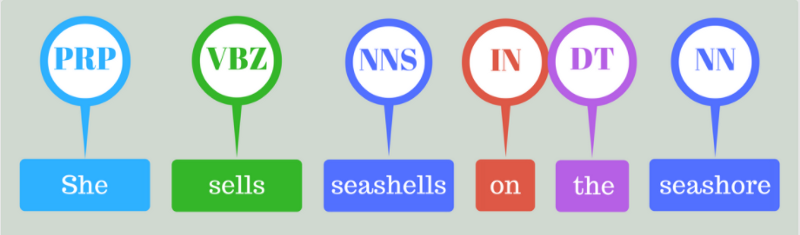
词性标注是一种监督学习解决方案,它使用前一个单词,下一个单词,首字母大写等功能.NLTK具有获取词性标注的功能,并且在断句分词(Tokenization)过程之后开始处理单词词性。
import nltk sentence = "My name is Jocelyn" token = nltk.word_tokenize(sentence) #分词 token 结果:
['My', 'name', 'is', 'Jocelyn'] ------------------------华丽分割线-------------------- nltk.pos_tag(token) #词性标注 结果:
[('My', 'PRP$'), ('name', 'NN'), ('is', 'VBZ'), ('Jocelyn', 'NNP')] ------------------------华丽分割线-------------------- # We can get more details about any POS tag using help funciton of NLTK as follows. nltk.help.upenn_tagset("PRP$") 结果:
PRP$: pronoun, possessive her his mine my our ours their thy your ------------------------华丽分割线-------------------- nltk.help.upenn_tagset("NN") 结果:
NN: noun, common, singular or mass common-carrier cabbage knuckle-duster Casino afghan shed thermostat investment slide humour falloff slick wind hyena override subhumanity machinist ... 最流行的标签集是Penn Treebank标签集。大多数已经训练过的英语标签都是在这个标签上训练的。要查看完整列表,请使用此链接。
组块分析(Chunking)
组块分析是从非结构化文本中提取短语的过程。相对于POS-Tagging来说,POS-Tagging返回了解析树的最底层,就是一个个单词。但是有时候你需要的是几个单词构成的名词短语,而非个个单词,在这种情况下,您可以使用chunker获取您需要的信息,而不是浪费时间为句子生成完整的解析树。举个例子(中文):与其要单个字,不如要一个词,例如,将“南非”之类的短语作为一个单独的词,而不是分别拆成“南”和“非”去理解。
组块分析是可以接着词性标注工作继续完成,它使用词性标注作为输入,并提供分析好的组块做为输出。与词性标注的标签类似,它也有一组标准的组块标签,如名词短语(np)、动词短语(vp)等,当你想从诸如位置,人名等文本中提取信息时,分块是非常重要的。在NLP中,称为命名实体识别,举个例子‘李雷的杯子’是分块分出的一个短语,而抽取’李雷’这个人名,就是命名体识别。所以,组块分析也是命名体识别的基础。
有很多库提供现成的短语,如spacy或textblob。NLTK只是提供了一种使用正则表达式生成块的机制。为了创建NP块(名词模式),我们将使用一个正则表达式规则来定义分块的语法。通常我们认为,一个名词词组由一个可选的限定词(dt),后跟任意数量的形容词(jj),然后是一个名词(nn),那么它就应该是名词短语NP(Noun Phrase)区块。
# Example of a simple regular expression based NP chunker. import nltk sentence = "the little yellow dog barked at the cat" #Define your grammar using regular expressions#Define  grammar = (''' NP: {

     ?

      *

       } # NP '''


   ) chunkParserchunkPar = nltk.RegexpParser(grammar) tagged = nltk.pos_tag(nltk.word_tokenize(sentence)) tagged
结果:
[('the', 'DT'), ('little', 'JJ'), ('yellow', 'JJ'), ('dog', 'NN'), ('barked', 'VBD'), ('at', 'IN'), ('the', 'DT'), ('cat', 'NN')] ------------------------华丽分割线-------------------- tree = chunkParser.parse(tagged) for subtree in tree.subtrees(): print(subtree) 结果:
(S (NP the/DT little/JJ yellow/JJ dog/NN) barked/VBD at/IN (NP the/DT cat/NN)) (NP the/DT little/JJ yellow/JJ dog/NN) (NP the/DT cat/NN) ------------------------华丽分割线-------------------- tree.draw() 发布者:全栈程序员-站长,转载请注明出处:https://javaforall.net/207754.html原文链接:https://javaforall.net




