
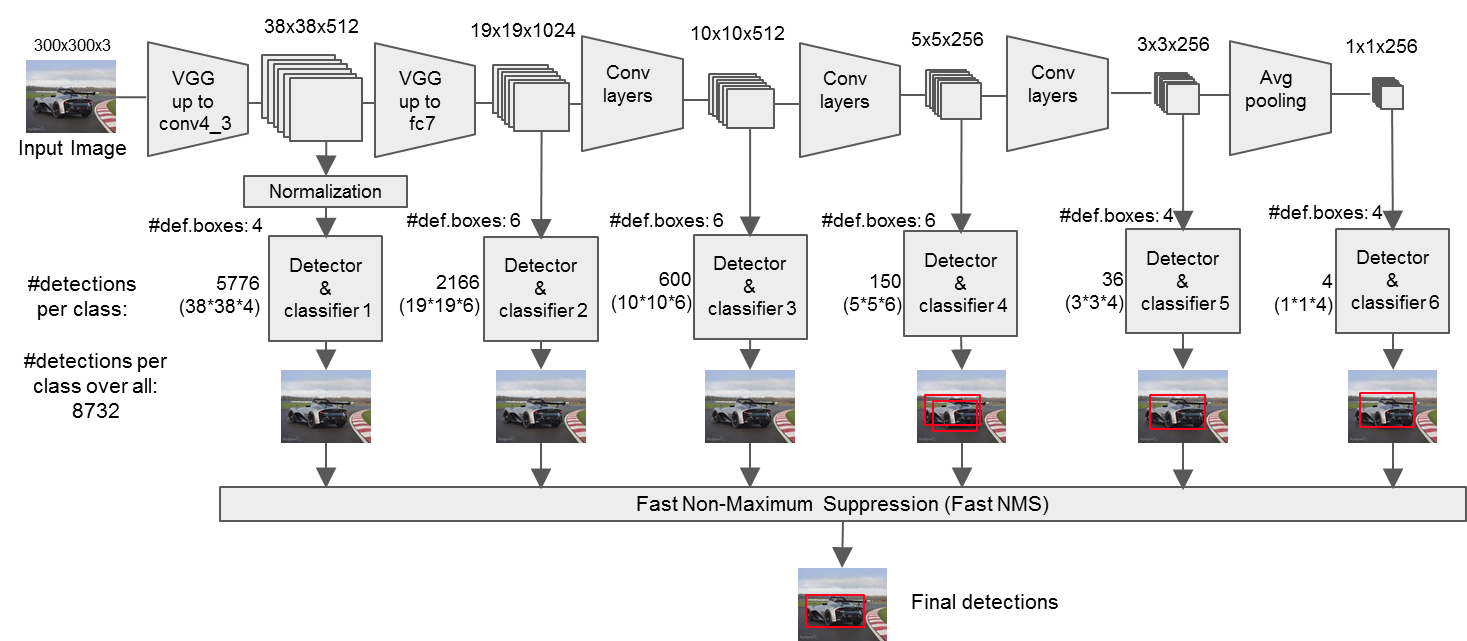

def build_ssd(phase, size=300, num_classes=21): if phase != "test" and phase != "train": print("ERROR: Phase: " + phase + " not recognized") return if size != 300: print("ERROR: You specified size " + repr(size) + ". However, " + "currently only SSD300 (size=300) is supported!") return base_, extras_, head_ = multibox(vgg(base[str(size)], 3), add_extras(extras[str(size)], 1024), mbox[str(size)], num_classes) return SSD(phase, size, base_, extras_, head_, num_classes) 网络大体分为三部分base_, extras_, head_
ssd主体网络:
class SSD(nn.Module): """Single Shot Multibox Architecture The network is composed of a base VGG network followed by the added multibox conv layers. Each multibox layer branches into 1) conv2d for class conf scores 2) conv2d for localization predictions 3) associated priorbox layer to produce default bounding boxes specific to the layer's feature map size. See: https://arxiv.org/pdf/1512.02325.pdf for more details. Args: phase: (string) Can be "test" or "train" size: input image size base: VGG16 layers for input, size of either 300 or 500 extras: extra layers that feed to multibox loc and conf layers head: "multibox head" consists of loc and conf conv layers """ def __init__(self, phase, size, base, extras, head, num_classes): super(SSD, self).__init__() self.phase = phase self.num_classes = num_classes self.cfg = (coco, voc)[num_classes == 21] self.priorbox = PriorBox(self.cfg) self.priors = Variable(self.priorbox.forward(), volatile=True) self.size = size # SSD network self.vgg = nn.ModuleList(base) # Layer learns to scale the l2 normalized features from conv4_3 self.L2Norm = L2Norm(512, 20) self.extras = nn.ModuleList(extras) self.loc = nn.ModuleList(head[0]) self.conf = nn.ModuleList(head[1]) if phase == 'test': self.softmax = nn.Softmax(dim=-1) self.detect = Detect(num_classes, 0, 200, 0.01, 0.45) def forward(self, x): """Applies network layers and ops on input image(s) x. Args: x: input image or batch of images. Shape: [batch,3,300,300]. Return: Depending on phase: test: Variable(tensor) of output class label predictions, confidence score, and corresponding location predictions for each object detected. Shape: [batch,topk,7] train: list of concat outputs from: 1: confidence layers, Shape: [batch*num_priors,num_classes] 2: localization layers, Shape: [batch,num_priors*4] 3: priorbox layers, Shape: [2,num_priors*4] """ sources = list() loc = list() conf = list() # apply vgg up to conv4_3 relu for k in range(23): x = self.vgg[k](x) s = self.L2Norm(x) sources.append(s) # apply vgg up to fc7 for k in range(23, len(self.vgg)): x = self.vgg[k](x) sources.append(x) # apply extra layers and cache source layer outputs for k, v in enumerate(self.extras): x = F.relu(v(x), inplace=True) if k % 2 == 1: sources.append(x) # apply multibox head to source layers for (x, l, c) in zip(sources, self.loc, self.conf): loc.append(l(x).permute(0, 2, 3, 1).contiguous()) conf.append(c(x).permute(0, 2, 3, 1).contiguous()) # loc_tmp = [o.view(o.size(0), -1) for o in loc] loc = torch.cat([o.view(o.size(0), -1) for o in loc], 1) conf = torch.cat([o.view(o.size(0), -1) for o in conf], 1) if self.phase == "test": output = self.detect( loc.view(loc.size(0), -1, 4), # loc preds self.softmax(conf.view(conf.size(0), -1, self.num_classes)), # conf preds self.priors.type(type(x.data)) # default boxes ) else: output = ( loc.view(loc.size(0), -1, 4), conf.view(conf.size(0), -1, self.num_classes), self.priors ) return output def load_weights(self, base_file): other, ext = os.path.splitext(base_file) if ext == '.pkl' or '.pth': print('Loading weights into state dict...') self.load_state_dict(torch.load(base_file, map_location=lambda storage, loc: storage)) print('Finished!') else: print('Sorry only .pth and .pkl files supported.') 通过pycharm打断点拷贝的ssd网络结构如下,只是网络所用到的一些模块,具体怎么用需要看forward部分:
SSD( (vgg): ModuleList( (0): Conv2d(3, 64, kernel_size=(3, 3), stride=(1, 1), padding=(1, 1)) (1): ReLU(inplace=True) (2): Conv2d(64, 64, kernel_size=(3, 3), stride=(1, 1), padding=(1, 1)) (3): ReLU(inplace=True) (4): MaxPool2d(kernel_size=2, stride=2, padding=0, dilation=1, ceil_mode=False) (5): Conv2d(64, 128, kernel_size=(3, 3), stride=(1, 1), padding=(1, 1)) (6): ReLU(inplace=True) (7): Conv2d(128, 128, kernel_size=(3, 3), stride=(1, 1), padding=(1, 1)) (8): ReLU(inplace=True) (9): MaxPool2d(kernel_size=2, stride=2, padding=0, dilation=1, ceil_mode=False) (10): Conv2d(128, 256, kernel_size=(3, 3), stride=(1, 1), padding=(1, 1)) (11): ReLU(inplace=True) (12): Conv2d(256, 256, kernel_size=(3, 3), stride=(1, 1), padding=(1, 1)) (13): ReLU(inplace=True) (14): Conv2d(256, 256, kernel_size=(3, 3), stride=(1, 1), padding=(1, 1)) (15): ReLU(inplace=True) (16): MaxPool2d(kernel_size=2, stride=2, padding=0, dilation=1, ceil_mode=True) (17): Conv2d(256, 512, kernel_size=(3, 3), stride=(1, 1), padding=(1, 1)) (18): ReLU(inplace=True) (19): Conv2d(512, 512, kernel_size=(3, 3), stride=(1, 1), padding=(1, 1)) (20): ReLU(inplace=True) (21): Conv2d(512, 512, kernel_size=(3, 3), stride=(1, 1), padding=(1, 1)) (22): ReLU(inplace=True) (23): MaxPool2d(kernel_size=2, stride=2, padding=0, dilation=1, ceil_mode=False) (24): Conv2d(512, 512, kernel_size=(3, 3), stride=(1, 1), padding=(1, 1)) (25): ReLU(inplace=True) (26): Conv2d(512, 512, kernel_size=(3, 3), stride=(1, 1), padding=(1, 1)) (27): ReLU(inplace=True) (28): Conv2d(512, 512, kernel_size=(3, 3), stride=(1, 1), padding=(1, 1)) (29): ReLU(inplace=True) (30): MaxPool2d(kernel_size=3, stride=1, padding=1, dilation=1, ceil_mode=False) (31): Conv2d(512, 1024, kernel_size=(3, 3), stride=(1, 1), padding=(6, 6), dilation=(6, 6)) (32): ReLU(inplace=True) (33): Conv2d(1024, 1024, kernel_size=(1, 1), stride=(1, 1)) (34): ReLU(inplace=True) ) (L2Norm): L2Norm() (extras): ModuleList( (0): Conv2d(1024, 256, kernel_size=(1, 1), stride=(1, 1)) (1): Conv2d(256, 512, kernel_size=(3, 3), stride=(2, 2), padding=(1, 1)) (2): Conv2d(512, 128, kernel_size=(1, 1), stride=(1, 1)) (3): Conv2d(128, 256, kernel_size=(3, 3), stride=(2, 2), padding=(1, 1)) (4): Conv2d(256, 128, kernel_size=(1, 1), stride=(1, 1)) (5): Conv2d(128, 256, kernel_size=(3, 3), stride=(1, 1)) (6): Conv2d(256, 128, kernel_size=(1, 1), stride=(1, 1)) (7): Conv2d(128, 256, kernel_size=(3, 3), stride=(1, 1)) ) (loc): ModuleList( (0): Conv2d(512, 16, kernel_size=(3, 3), stride=(1, 1), padding=(1, 1)) (1): Conv2d(1024, 24, kernel_size=(3, 3), stride=(1, 1), padding=(1, 1)) (2): Conv2d(512, 24, kernel_size=(3, 3), stride=(1, 1), padding=(1, 1)) (3): Conv2d(256, 24, kernel_size=(3, 3), stride=(1, 1), padding=(1, 1)) (4): Conv2d(256, 16, kernel_size=(3, 3), stride=(1, 1), padding=(1, 1)) (5): Conv2d(256, 16, kernel_size=(3, 3), stride=(1, 1), padding=(1, 1)) ) (conf): ModuleList( (0): Conv2d(512, 84, kernel_size=(3, 3), stride=(1, 1), padding=(1, 1)) (1): Conv2d(1024, 126, kernel_size=(3, 3), stride=(1, 1), padding=(1, 1)) (2): Conv2d(512, 126, kernel_size=(3, 3), stride=(1, 1), padding=(1, 1)) (3): Conv2d(256, 126, kernel_size=(3, 3), stride=(1, 1), padding=(1, 1)) (4): Conv2d(256, 84, kernel_size=(3, 3), stride=(1, 1), padding=(1, 1)) (5): Conv2d(256, 84, kernel_size=(3, 3), stride=(1, 1), padding=(1, 1)) ) ) ---------------------------------------------------------------- Layer (type) Output Shape Param # ================================================================ Conv2d-1 [-1, 64, 300, 300] 1,792 ReLU-2 [-1, 64, 300, 300] 0 Conv2d-3 [-1, 64, 300, 300] 36,928 ReLU-4 [-1, 64, 300, 300] 0 MaxPool2d-5 [-1, 64, 150, 150] 0 Conv2d-6 [-1, 128, 150, 150] 73,856 ReLU-7 [-1, 128, 150, 150] 0 Conv2d-8 [-1, 128, 150, 150] 147,584 ReLU-9 [-1, 128, 150, 150] 0 MaxPool2d-10 [-1, 128, 75, 75] 0 Conv2d-11 [-1, 256, 75, 75] 295,168 ReLU-12 [-1, 256, 75, 75] 0 Conv2d-13 [-1, 256, 75, 75] 590,080 ReLU-14 [-1, 256, 75, 75] 0 Conv2d-15 [-1, 256, 75, 75] 590,080 ReLU-16 [-1, 256, 75, 75] 0 MaxPool2d-17 [-1, 256, 38, 38] 0 Conv2d-18 [-1, 512, 38, 38] 1,180,160 ReLU-19 [-1, 512, 38, 38] 0 Conv2d-20 [-1, 512, 38, 38] 2,359,808 ReLU-21 [-1, 512, 38, 38] 0 Conv2d-22 [-1, 512, 38, 38] 2,359,808 ReLU-23 [-1, 512, 38, 38] 0 L2Norm-24 [-1, 512, 38, 38] 512 MaxPool2d-25 [-1, 512, 19, 19] 0 Conv2d-26 [-1, 512, 19, 19] 2,359,808 ReLU-27 [-1, 512, 19, 19] 0 Conv2d-28 [-1, 512, 19, 19] 2,359,808 ReLU-29 [-1, 512, 19, 19] 0 Conv2d-30 [-1, 512, 19, 19] 2,359,808 ReLU-31 [-1, 512, 19, 19] 0 MaxPool2d-32 [-1, 512, 19, 19] 0 Conv2d-33 [-1, 1024, 19, 19] 4,719,616 ReLU-34 [-1, 1024, 19, 19] 0 Conv2d-35 [-1, 1024, 19, 19] 1,049,600 ReLU-36 [-1, 1024, 19, 19] 0 Conv2d-37 [-1, 256, 19, 19] 262,400 Conv2d-38 [-1, 512, 10, 10] 1,180,160 Conv2d-39 [-1, 128, 10, 10] 65,664 Conv2d-40 [-1, 256, 5, 5] 295,168 Conv2d-41 [-1, 128, 5, 5] 32,896 Conv2d-42 [-1, 256, 3, 3] 295,168 Conv2d-43 [-1, 128, 3, 3] 32,896 Conv2d-44 [-1, 256, 1, 1] 295,168 Conv2d-45 [-1, 16, 38, 38] 73,744 Conv2d-46 [-1, 84, 38, 38] 387,156 Conv2d-47 [-1, 24, 19, 19] 221,208 Conv2d-48 [-1, 126, 19, 19] 1,161,342 Conv2d-49 [-1, 24, 10, 10] 110,616 Conv2d-50 [-1, 126, 10, 10] 580,734 Conv2d-51 [-1, 24, 5, 5] 55,320 Conv2d-52 [-1, 126, 5, 5] 290,430 Conv2d-53 [-1, 16, 3, 3] 36,880 Conv2d-54 [-1, 84, 3, 3] 193,620 Conv2d-55 [-1, 16, 1, 1] 36,880 Conv2d-56 [-1, 84, 1, 1] 193,620 ================================================================ Total params: 26,285,486 Trainable params: 26,285,486 Non-trainable params: 0 ---------------------------------------------------------------- Input size (MB): 1.03 Forward/backward pass size (MB): 413.90 Params size (MB): 100.27 Estimated Total Size (MB): 515.20 ---------------------------------------------------------------- 具体计算规则都在ssd里面的forward函数里面,
def forward(self, x): sources = list() loc = list() conf = list() # apply vgg up to conv4_3 relu for k in range(23): x = self.vgg[k](x) s = self.L2Norm(x) sources.append(s) s0 # apply vgg up to fc7 for k in range(23, len(self.vgg)): x = self.vgg[k](x) sources.append(x)s1 # apply extra layers and cache source layer outputs for k, v in enumerate(self.extras): k=0,1,2,3,4,5,6,7 奇数的时候保存一次sources,总共保存4个 x = F.relu(v(x), inplace=True) if k % 2 == 1: sources.append(x) # apply multibox head to source layers for (x, l, c) in zip(sources, self.loc, self.conf): loc.append(l(x).permute(0, 2, 3, 1).contiguous()) conf.append(c(x).permute(0, 2, 3, 1).contiguous()) # loc_tmp = [o.view(o.size(0), -1) for o in loc] loc = torch.cat([o.view(o.size(0), -1) for o in loc], 1) conf = torch.cat([o.view(o.size(0), -1) for o in conf], 1) if self.phase == "test": output = self.detect( loc.view(loc.size(0), -1, 4), # loc preds self.softmax(conf.view(conf.size(0), -1, self.num_classes)), # conf preds self.priors.type(type(x.data)) # default boxes ) else: output = ( loc.view(loc.size(0), -1, 4), conf.view(conf.size(0), -1, self.num_classes), self.priors ) return output 保存了6个不同层次的feature map在sources中,然后用loc和conf去卷积得到结果,然后就是各种reshape操作。最后打包输出:
output = ( loc.view(loc.size(0), -1, 4), #[batchsize,8732,4] conf.view(conf.size(0), -1, self.num_classes),#[batchsize,8732,21] self.priors #[8732,4] ) 版权声明:本文内容由互联网用户自发贡献,该文观点仅代表作者本人。本站仅提供信息存储空间服务,不拥有所有权,不承担相关法律责任。如发现本站有涉嫌侵权/违法违规的内容, 请联系我们举报,一经查实,本站将立刻删除。
发布者:全栈程序员-站长,转载请注明出处:https://javaforall.net/207846.html原文链接:https://javaforall.net




