对于kNN算法,难点在于计算测试集中每一样本到训练集中每一样本的欧氏距离,即计算两个矩阵之间的欧氏距离。现就计算欧式距离提出三种方法。
欧式距离:https://baike.baidu.com/item/欧几里得度量/1274107?fromtitle=欧式距离&fromid=2809635&fr=aladdin
1. 两层循环
分别对训练集和测试集中的数据进行循环遍历,计算每两个样本之间的欧式距离。此算法没有经过任何优化。
import numpy as np matrix_1 = np.array([[1, 2, 3], [4, 5, 6], [7, 8, 9]]) matrix_2 = np.array([[1, 2, 3], [4, 5, 6], [7, 8, 9], [3, 2, 1], [6, 5, 4], [9, 8, 7]]) def compute_distances_two_loop(test_matrix, train_matrix): num_test = test_matrix.shape[0] num_train = train_matrix.shape[0] dists = np.zeros((num_test, num_train)) # shape(num_test, num-train) for i in range(num_test): for j in range(num_train): # corresponding element in Numpy Array can compute directly,such as plus, multiply dists[i][j] = np.sqrt(np.sum(np.square(test_matrix[i] - train_matrix[j]))) return dists compute_distances_two_loop(matrix_1, matrix_2) 

2. 一层循环
利用Numpy广播机制(参见下一篇博客)对方法一进行优化,使用一层循环。
def compute_distances_one_loop(test_matrix, train_matrix): num_test = test_matrix.shape[0] num_train = train_matrix.shape[0] dists = np.zeros((num_test, num_train)) for i in range(num_test): dists[i] = np.sqrt(np.sum(np.square(test_matrix[i] - train_matrix), axis=1)) # 注:这里用到了广播机制,test_matrix[i]维度为(3,),train_matrix维度为(6, 3), # 计算结果维度为(6, 3),表示 test_matrix[i] 与 train_matrix 各个样本在各个轴的差值, # 最后平方后在axis=1维度进行求和。 return dists compute_distances_one_loop(matrix_1, matrix_2)

3. 不使用循环
计算效率最高的算法是将训练集和测试集都使用矩阵表示,然后使用矩阵运算的方法替代之前的循环操作。但矩阵运算要求我们对矩阵的运算规则非常熟悉。现就计算两个矩阵之间的欧式距离的矩阵运算进行推导。
矩阵之间的欧式距离物理意义:测试集每个样本与训练集每个样本的L2范式。 显然,最后的结果维度应该是(num_test, num_train)。
假设测试集矩阵T的大小为MD,训练集矩阵P的大小为ND(测试集中共有M个点,每个点为D维特征向量;训练集中共有N个点,每个点为D维特征向量)。
记Ti是测试集矩阵T的第i行,Pj是训练集矩阵P的第j行。
- 计算Ti与Pj之间的距离dists[i][j]:
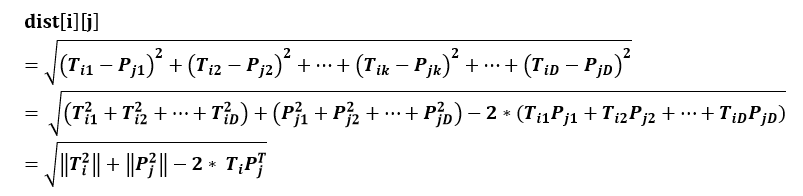
- 推广到距离矩阵的第i行的计算公式:

- 将公式推广为整个距离矩阵 :
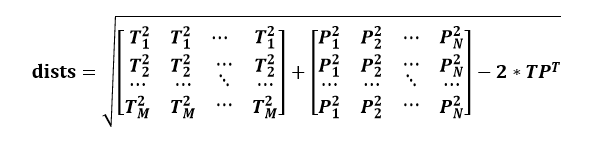
具体实现见下:
def non_loop(test_matrix, train_matrix): num_test = test_matrix.shape[0] num_train = train_matrix.shape[0] dists = np.zeros((num_test, num_train)) # because(X - X_train)*(X - X_train) = -2X*X_train + X*X + X_train*X_train, so d1 = -2 * np.dot(test_matrix, train_matrix.T) # shape (num_test, num_train) d2 = np.sum(np.square(test_matrix), axis=1, keepdims=True) # shape (num_test, 1) d3 = np.sum(np.square(train_matrix), axis=1) # shape (num_train, ) dists = np.sqrt(d1 + d2 + d3) # broadcasting return dists non_loop(matrix_1, matrix_2)
注:Numpy数组运算的广播机制与对应元素运算原则。

版权声明:本文内容由互联网用户自发贡献,该文观点仅代表作者本人。本站仅提供信息存储空间服务,不拥有所有权,不承担相关法律责任。如发现本站有涉嫌侵权/违法违规的内容, 请联系我们举报,一经查实,本站将立刻删除。
发布者:全栈程序员-站长,转载请注明出处:https://javaforall.net/228299.html原文链接:https://javaforall.net