
backbone
Resnet34网络结构图:
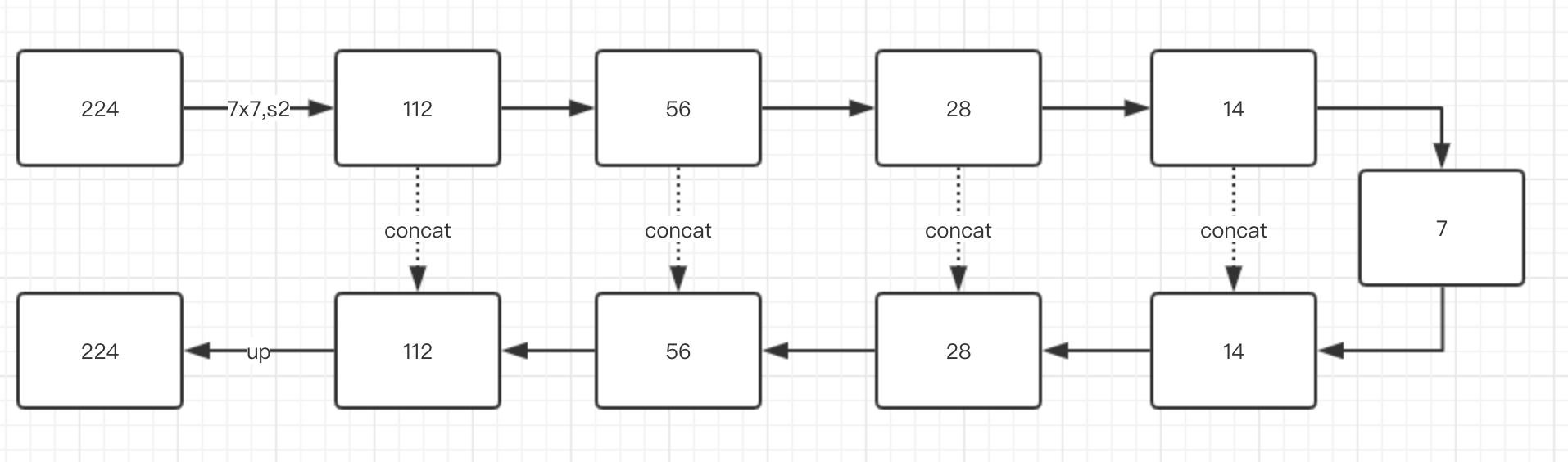
其中在网络搭建的过程中分为4个stage,蓝色箭头是在Unet中要进行合并的层。注意:前向的运算encoder过程一共经过了5次降采样,包括刚开始的 7 ∗ 7 7*7 7∗7卷积 stride,所以decoder过程要有5次上采样的过程,但是跨层连接(encoder 与 decoder之间)只有4次,如下图所示,以输入图像大小224×224为例:


Resnet34代码搭建(keras)
卷积block搭建
def basic_identity_block(filters, stage, block): """The identity block is the block that has no conv layer at shortcut. # Arguments kernel_size: default 3, the kernel size of middle conv layer at main path filters: list of integers, the filters of 3 conv layer at main path stage: integer, current stage label, used for generating layer names block: 'a','b'..., current block label, used for generating layer names # Returns Output tensor for the block. """ def layer(input_tensor): conv_params = get_conv_params() bn_params = get_bn_params() conv_name, bn_name, relu_name, sc_name = handle_block_names(stage, block) x = BatchNormalization(name=bn_name + '1', bn_params)(input_tensor) x = Activation('relu', name=relu_name + '1')(x) x = ZeroPadding2D(padding=(1, 1))(x) x = Conv2D(filters, (3, 3), name=conv_name + '1', conv_params)(x) x = BatchNormalization(name=bn_name + '2', bn_params)(x) x = Activation('relu', name=relu_name + '2')(x) x = ZeroPadding2D(padding=(1, 1))(x) x = Conv2D(filters, (3, 3), name=conv_name + '2', conv_params)(x) x = Add()([x, input_tensor]) return x return layer def basic_conv_block(filters, stage, block, strides=(2, 2)): """The identity block is the block that has no conv layer at shortcut. # Arguments input_tensor: input tensor kernel_size: default 3, the kernel size of middle conv layer at main path filters: list of integers, the filters of 3 conv layer at main path stage: integer, current stage label, used for generating layer names block: 'a','b'..., current block label, used for generating layer names # Returns Output tensor for the block. """ def layer(input_tensor): conv_params = get_conv_params() bn_params = get_bn_params() conv_name, bn_name, relu_name, sc_name = handle_block_names(stage, block) x = BatchNormalization(name=bn_name + '1', bn_params)(input_tensor) x = Activation('relu', name=relu_name + '1')(x) shortcut = x x = ZeroPadding2D(padding=(1, 1))(x) x = Conv2D(filters, (3, 3), strides=strides, name=conv_name + '1', conv_params)(x) x = BatchNormalization(name=bn_name + '2', bn_params)(x) x = Activation('relu', name=relu_name + '2')(x) x = ZeroPadding2D(padding=(1, 1))(x) x = Conv2D(filters, (3, 3), name=conv_name + '2', conv_params)(x) shortcut = Conv2D(filters, (1, 1), name=sc_name, strides=strides, conv_params)(shortcut) x = Add()([x, shortcut]) return x return layer Resnet34网络搭建
网络结构即如上图所示。
def build_resnet( repetitions=(2, 2, 2, 2), include_top=True, input_tensor=None, input_shape=None, classes=1000, block_type='usual'): # Determine proper input shape input_shape = _obtain_input_shape(input_shape, default_size=224, min_size=197, data_format='channels_last', require_flatten=include_top) if input_tensor is None: img_input = Input(shape=input_shape, name='data') else: if not K.is_keras_tensor(input_tensor): img_input = Input(tensor=input_tensor, shape=input_shape) else: img_input = input_tensor # get parameters for model layers no_scale_bn_params = get_bn_params(scale=False) bn_params = get_bn_params() conv_params = get_conv_params() init_filters = 64 if block_type == 'basic': conv_block = basic_conv_block identity_block = basic_identity_block else: conv_block = usual_conv_block identity_block = usual_identity_block # renet bottom x = BatchNormalization(name='bn_data', no_scale_bn_params)(img_input) x = ZeroPadding2D(padding=(3, 3))(x) x = Conv2D(init_filters, (7, 7), strides=(2, 2), name='conv0', conv_params)(x) x = BatchNormalization(name='bn0', bn_params)(x) x = Activation('relu', name='relu0')(x) x = ZeroPadding2D(padding=(1, 1))(x) x = MaxPooling2D((3, 3), strides=(2, 2), padding='valid', name='pooling0')(x) # resnet body repetitions = (3,4,6,3) for stage, rep in enumerate(repetitions): for block in range(rep): # print(block) filters = init_filters * (2stage) # first block of first stage without strides because we have maxpooling before if block == 0 and stage == 0: # x = conv_block(filters, stage, block, strides=(1, 1))(x) x = identity_block(filters, stage, block)(x) continue elif block == 0: x = conv_block(filters, stage, block, strides=(2, 2))(x) else: x = identity_block(filters, stage, block)(x) x = BatchNormalization(name='bn1', bn_params)(x) x = Activation('relu', name='relu1')(x) # resnet top if include_top: x = GlobalAveragePooling2D(name='pool1')(x) x = Dense(classes, name='fc1')(x) x = Activation('softmax', name='softmax')(x) # Ensure that the model takes into account any potential predecessors of `input_tensor`. if input_tensor is not None: inputs = get_source_inputs(input_tensor) else: inputs = img_input # Create model. model = Model(inputs, x) return model def ResNet34(input_shape, input_tensor=None, weights=None, classes=1000, include_top=True): model = build_resnet(input_tensor=input_tensor, input_shape=input_shape, repetitions=(3, 4, 6, 3), classes=classes, include_top=include_top, block_type='basic') model.name = 'resnet34' if weights: load_model_weights(weights_collection, model, weights, classes, include_top) return model decoder过程
def build_unet(backbone, classes, skip_connection_layers, decoder_filters=(256,128,64,32,16), upsample_rates=(2,2,2,2,2), n_upsample_blocks=5, block_type='upsampling', activation='sigmoid', use_batchnorm=True): input = backbone.input x = backbone.output if block_type == 'transpose': up_block = Transpose2D_block else: up_block = Upsample2D_block # convert layer names to indices skip_connection_idx = ([get_layer_number(backbone, l) if isinstance(l, str) else l for l in skip_connection_layers]) # print(skip_connection_idx) [128, 73, 36, 5] for i in range(n_upsample_blocks): # print(i) # check if there is a skip connection skip_connection = None if i < len(skip_connection_idx): skip_connection = backbone.layers[skip_connection_idx[i]].output # print(backbone.layers[skip_connection_idx[i]]) #
参考:
- https://www.kaggle.com/meaninglesslives/unet-resnet34-in-keras
- https://github.com/qubvel/segmentation_models/blob/master/segmentation_models/unet/model.py
版权声明:本文内容由互联网用户自发贡献,该文观点仅代表作者本人。本站仅提供信息存储空间服务,不拥有所有权,不承担相关法律责任。如发现本站有涉嫌侵权/违法违规的内容, 请联系我们举报,一经查实,本站将立刻删除。
发布者:全栈程序员-站长,转载请注明出处:https://javaforall.net/229092.html原文链接:https://javaforall.net