大家好,又见面了,我是全栈君,今天给大家准备了Idea注册码。
http://poj.org/problem?id=2632
Crashing Robots
| Time Limit: 1000MS | Memory Limit: 65536K | |
| Total Submissions: 7470 | Accepted: 3265 |
Description
In a modernized warehouse, robots are used to fetch the goods. Careful planning is needed to ensure that the robots reach their destinations without crashing into each other. Of course, all warehouses are rectangular, and all robots occupy a circular floor space with a diameter of 1 meter. Assume there are N robots, numbered from 1 through N. You will get to know the position and orientation of each robot, and all the instructions, which are carefully (and mindlessly) followed by the robots. Instructions are processed in the order they come. No two robots move simultaneously; a robot always completes its move before the next one starts moving.
A robot crashes with a wall if it attempts to move outside the area of the warehouse, and two robots crash with each other if they ever try to occupy the same spot.
A robot crashes with a wall if it attempts to move outside the area of the warehouse, and two robots crash with each other if they ever try to occupy the same spot.
Input
The first line of input is K, the number of test cases. Each test case starts with one line consisting of two integers, 1 <= A, B <= 100, giving the size of the warehouse in meters. A is the length in the EW-direction, and B in the NS-direction.
The second line contains two integers, 1 <= N, M <= 100, denoting the numbers of robots and instructions respectively.
Then follow N lines with two integers, 1 <= Xi <= A, 1 <= Yi <= B and one letter (N, S, E or W), giving the starting position and direction of each robot, in order from 1 through N. No two robots start at the same position.
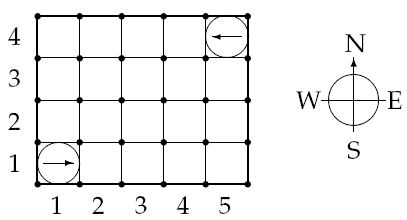

Figure 1: The starting positions of the robots in the sample warehouse
Finally there are M lines, giving the instructions in sequential order.
An instruction has the following format:
< robot #> < action> < repeat>
Where
is one of
The second line contains two integers, 1 <= N, M <= 100, denoting the numbers of robots and instructions respectively.
Then follow N lines with two integers, 1 <= Xi <= A, 1 <= Yi <= B and one letter (N, S, E or W), giving the starting position and direction of each robot, in order from 1 through N. No two robots start at the same position.
Figure 1: The starting positions of the robots in the sample warehouse
Finally there are M lines, giving the instructions in sequential order.
An instruction has the following format:
< robot #> < action> < repeat>
Where
is one of
- L: turn left 90 degrees,
- R: turn right 90 degrees, or
- F: move forward one meter,
and 1 <= < repeat> <= 100 is the number of times the robot should perform this single move.
Output
Output one line for each test case:
- Robot i crashes into the wall, if robot i crashes into a wall. (A robot crashes into a wall if Xi = 0, Xi = A + 1, Yi = 0 or Yi = B + 1.)
- Robot i crashes into robot j, if robots i and j crash, and i is the moving robot.
- OK, if no crashing occurs.
Only the first crash is to be reported.
Sample Input
4
5 4
2 2
1 1 E
5 4 W
1 F 7
2 F 7
5 4
2 4
1 1 E
5 4 W
1 F 3
2 F 1
1 L 1
1 F 3
5 4
2 2
1 1 E
5 4 W
1 L 96
1 F 2
5 4
2 3
1 1 E
5 4 W
1 F 4
1 L 1
1 F 20
Sample Output
Robot 1 crashes into the wall
Robot 1 crashes into robot 2
OK
Robot 1 crashes into robot 2
Source
//赤裸裸的模拟,開始有点卡,就是依照题意一步步来就好了,注意是假设碰撞就标记。仅仅推断第一次就好。
#include<cstdio>
#include<cstring>
struct point
{
    int x,y;
    char c;
}f[105];
struct node
{
    int x,y;
    char c;
}ff[105];
int a,b,n,m;
bool check(int k)  //推断函数,開始就是有点卡这里
{
    int i;
    if(f[k].x<=0||f[k].x>a||f[k].y<=0||f[k].y>b) //跟墙碰撞
    {
        printf("Robot %d crashes into the wall\n",k);
        return 1;
    }
    for(i=1;i<=n;i++)   //跟其他机器人碰撞
    {
        if(i==k) continue;
        if(f[k].x==f[i].x&&f[k].y==f[i].y)
        {
           printf("Robot %d crashes into robot %d\n",k,i);
           return 1;
        }
    }
    return 0;
}
int main()
{
    //freopen("a.txt","r",stdin);
    int t,i,j,l,k,flag;
    scanf("%d",&t);
    while(t--)
    {
        scanf("%d%d%d%d",&a,&b,&n,&m);
        for(i=1;i<=n;i++)
        {
            scanf("%d%d %c",&f[i].x,&f[i].y,&f[i].c);
            //printf("%d%d%c\n",f[i].x,f[i].y,f[i].c);
        }
        flag=0;
        for(i=1;i<=m;i++)
        {
            scanf("%d %c %d",&ff[i].x,&ff[i].c,&ff[i].y);
            //printf("%d%c%d\n",ff[i].x,ff[i].c,ff[i].y);
            //
            k=ff[i].x;
            if(ff[i].c=='L')
            {
                l=ff[i].y%4; //4个方向一个周期  看剩下多少步
                for(j=1;j<=l;j++)
                {
                    if(f[k].c=='N')
                        f[k].c='W';
                    else if(f[k].c=='E')
                        f[k].c='N';
                    else if(f[k].c=='S')
                        f[k].c='E';
                    else if(f[k].c=='W')
                        f[k].c='S';
                }
            }
            else if(ff[i].c=='R')
            {
                l=ff[i].y%4; //同理
                for(j=1;j<=l;j++)
                {
                    if(f[k].c=='N')
                        f[k].c='E';
                    else if(f[k].c=='E')
                        f[k].c='S';
                    else if(f[k].c=='S')
                        f[k].c='W';
                    else if(f[k].c=='W')
                        f[k].c='N';
                }
            }
            else
            {
                l=ff[i].y;
                if(!flag)   //仅仅须要推断一次即可。
                {
                for(j=1;j<=l;j++)
                {
                    if(f[k].c=='N')
                    {
                        f[k].y++;
                        flag=check(k);
                        if(flag)break;
                    }
                    else if(f[k].c=='W')
                    {
                        f[k].x--;
                        flag=check(k);
                        if(flag)break;
                    }
                    else if(f[k].c=='S')
                    {
                        f[k].y--;
                        flag=check(k);
                        if(flag) break;
                    }
                    else if(f[k].c=='E')
                    {
                        f[k].x++;
                        flag=check(k);
                        if(flag)break;
                    }
                }
                }
            }
        }
        if(!flag) printf("OK\n");
    }
    return 0;
}
版权声明:本文博主原创文章,博客,未经同意不得转载。
版权声明:本文内容由互联网用户自发贡献,该文观点仅代表作者本人。本站仅提供信息存储空间服务,不拥有所有权,不承担相关法律责任。如发现本站有涉嫌侵权/违法违规的内容, 请联系我们举报,一经查实,本站将立刻删除。
发布者:全栈程序员-站长,转载请注明出处:https://javaforall.net/116827.html原文链接:https://javaforall.net