
大家好,又见面了,我是你们的朋友全栈君。如果您正在找激活码,请点击查看最新教程,关注关注公众号 “全栈程序员社区” 获取激活教程,可能之前旧版本教程已经失效.最新Idea2022.1教程亲测有效,一键激活。
Jetbrains全系列IDE稳定放心使用


程序老哥,一名10年老程序猿,目前为广告系统技术负责人,长期工作在一线主要关注服务器后端的开发,在Java、微服务、Docker、高可用架构均有深入实践。本博客以后的更新全部迁移到微信公众号上,欢迎大家都关注本公众号,我会定时的更新各种技术文章,方便大家学习进步。
由于MyBatis属于一种半自动的ORM框架,所以主要的工作将是书写Mapping映射文件,但是由于手写映射文件很容易出错,所以查资料发现有现成的工具可以自动生成底层模型类、Dao接口类甚至Mapping映射文件。
一、建立表结构
CREATE TABLE `user` (
`id` varchar(50) NOT NULL,
`username` varchar(18) CHARACTER SET utf8 COLLATE utf8_bin DEFAULT NULL,
`password` varchar(18) DEFAULT NULL,
`email` varchar(50) DEFAULT NULL,
`name` varchar(18) DEFAULT NULL,
`sex` varchar(2) DEFAULT NULL,
`birthday` varchar(50) DEFAULT NULL,
`address` varchar(500) DEFAULT NULL,
`tel` varchar(18) DEFAULT NULL,
`qq` varchar(18) DEFAULT NULL,
`image` varchar(50) DEFAULT NULL,
`sfjh` varchar(1) DEFAULT NULL,
`sfzx` varchar(1) DEFAULT NULL,
`sfhf` varchar(1) DEFAULT NULL,
`sfpl` varchar(1) DEFAULT NULL,
`sffx` varchar(1) DEFAULT NULL,
PRIMARY KEY (`id`)
) ENGINE=InnoDB DEFAULT CHARSET=utf-8;
二、下载mybatis-generator-core
进入:http://code.google.com/p/mybatis/
选择Downloads,再选择MyBatis Generator Tool下载即可。
三、生成配置文件
新建一个空的XML配置文件,名称可以随便取,这里以generatorConfig.xml为名。最好将这个文件放在下载后的lib目录中,如图:
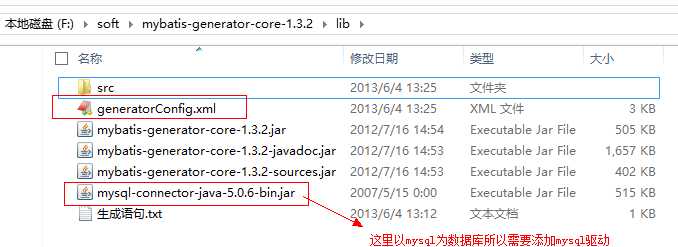
其中mysql的驱动可以随便放在非中文路径的地方,这里为了方便就放在lib目录下。
自动生成最重要的就是配置文件的书写,现在就开始介绍generatorConfig.xml这个文件的具体内容:
<?xml version="1.0" encoding="UTF-8"?>
<!DOCTYPE generatorConfiguration
  PUBLIC "-//mybatis.org//DTD MyBatis Generator Configuration 1.0//EN"
  "http://mybatis.org/dtd/mybatis-generator-config_1_0.dtd">
<generatorConfiguration>
<!-- 数据库驱动-->
	<classPathEntry	location="mysql-connector-java-5.0.6-bin.jar"/>
	<context id="DB2Tables"	targetRuntime="MyBatis3">
		<commentGenerator>
			<property name="suppressDate" value="true"/>
			<!-- 是否去除自动生成的注释 true:是 : false:否 -->
			<property name="suppressAllComments" value="true"/>
		</commentGenerator>
		<!--数据库链接URL,用户名、密码 -->
		<jdbcConnection driverClass="com.mysql.jdbc.Driver" connectionURL="jdbc:mysql://localhost/test" userId="test" password="test">
		</jdbcConnection>
		<javaTypeResolver>
			<property name="forceBigDecimals" value="false"/>
		</javaTypeResolver>
		<!-- 生成模型的包名和位置-->
		<javaModelGenerator targetPackage="test.model" targetProject="src">
			<property name="enableSubPackages" value="true"/>
			<property name="trimStrings" value="true"/>
		</javaModelGenerator>
		<!-- 生成映射文件的包名和位置-->
		<sqlMapGenerator targetPackage="test.mapping" targetProject="src">
			<property name="enableSubPackages" value="true"/>
		</sqlMapGenerator>
		<!-- 生成DAO的包名和位置-->
		<javaClientGenerator type="XMLMAPPER" targetPackage="test.dao" targetProject="src">
			<property name="enableSubPackages" value="true"/>
		</javaClientGenerator>
		<!-- 要生成哪些表-->
		<table tableName="about" domainObjectName="AboutDto" enableCountByExample="false" enableUpdateByExample="false" enableDeleteByExample="false" enableSelectByExample="false" selectByExampleQueryId="false"></table>
		<table tableName="user" domainObjectName="UserDto" enableCountByExample="false" enableUpdateByExample="false" enableDeleteByExample="false" enableSelectByExample="false" selectByExampleQueryId="false"></table>
		<table tableName="syslogs" domainObjectName="SyslogsDto" enableCountByExample="false" enableUpdateByExample="false" enableDeleteByExample="false" enableSelectByExample="false" selectByExampleQueryId="false"></table>
	</context>
</generatorConfiguration>
1、其中需要注意的有数据库驱动、数据库URL、用户名、密码、生成模型的包名和位置、生成映射文件的包名和位置、生成DAO的包名和位置以及最后需要生成的表名和对应的类名。
四、运行
需要通过CMD命令行方式来运行,首先可以先准备一个运行的脚本,这里使用的脚本是:java -jar mybatis-generator-core-1.3.2.jar -configfile generatorConfig.xml -overwrite
需要注意的是:mybatis-generator-core-1.3.2.jar为下载的对应版本的jar,generatorConfig.xml 为配置文件名,如果不为这个可以在这里进行修改。
启动cmd进入到“F:\soft\mybatis-generator-core-1.3.2\lib”这个目录下,如图:
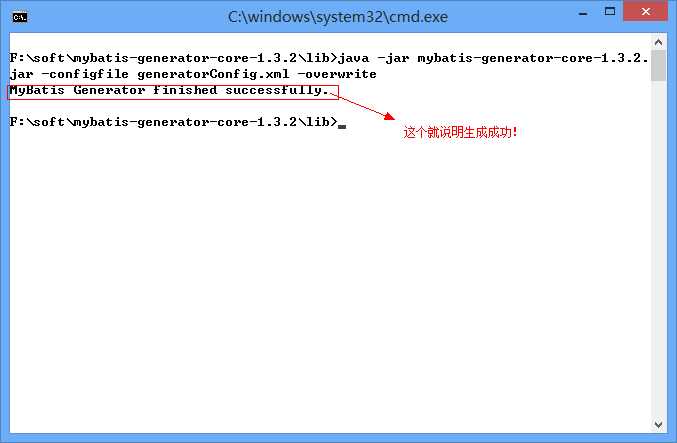
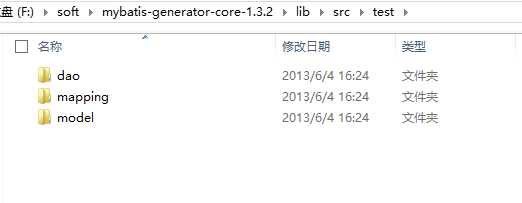
生成成功后进到src目录下,可以看到已经生成了对应的model、dao、mapping,如图:
下面可以看看生成后的UserMapper.xml
<?xml version="1.0" encoding="UTF-8" ?>
<!DOCTYPE mapper PUBLIC "-//mybatis.org//DTD Mapper 3.0//EN" "http://mybatis.org/dtd/mybatis-3-mapper.dtd" >
<mapper namespace="test.dao.UserDtoMapper" >
  <resultMap id="BaseResultMap" type="test.model.UserDto" >
    <id column="id" property="id" jdbcType="VARCHAR" />
    <result column="username" property="username" jdbcType="VARCHAR" />
    <result column="password" property="password" jdbcType="VARCHAR" />
    <result column="email" property="email" jdbcType="VARCHAR" />
    <result column="name" property="name" jdbcType="VARCHAR" />
    <result column="sex" property="sex" jdbcType="VARCHAR" />
    <result column="birthday" property="birthday" jdbcType="VARCHAR" />
    <result column="address" property="address" jdbcType="VARCHAR" />
    <result column="tel" property="tel" jdbcType="VARCHAR" />
    <result column="qq" property="qq" jdbcType="VARCHAR" />
    <result column="image" property="image" jdbcType="VARCHAR" />
    <result column="sfjh" property="sfjh" jdbcType="VARCHAR" />
    <result column="sfzx" property="sfzx" jdbcType="VARCHAR" />
    <result column="sfhf" property="sfhf" jdbcType="VARCHAR" />
    <result column="sfpl" property="sfpl" jdbcType="VARCHAR" />
    <result column="sffx" property="sffx" jdbcType="VARCHAR" />
  </resultMap>
  <sql id="Base_Column_List" >
    id, username, password, email, name, sex, birthday, address, tel, qq, image, sfjh,
    sfzx, sfhf, sfpl, sffx
  </sql>
  <select id="selectByPrimaryKey" resultMap="BaseResultMap" parameterType="java.lang.String" >
    select
    <include refid="Base_Column_List" />
    from user
    where id = #{id,jdbcType=VARCHAR}
  </select>
  <delete id="deleteByPrimaryKey" parameterType="java.lang.String" >
    delete from user
    where id = #{id,jdbcType=VARCHAR}
  </delete>
  <insert id="insert" parameterType="test.model.UserDto" >
    insert into user (id, username, password,
      email, name, sex, birthday,
      address, tel, qq, image,
      sfjh, sfzx, sfhf, sfpl,
      sffx)
    values (#{id,jdbcType=VARCHAR}, #{username,jdbcType=VARCHAR}, #{password,jdbcType=VARCHAR},
      #{email,jdbcType=VARCHAR}, #{name,jdbcType=VARCHAR}, #{sex,jdbcType=VARCHAR}, #{birthday,jdbcType=VARCHAR},
      #{address,jdbcType=VARCHAR}, #{tel,jdbcType=VARCHAR}, #{qq,jdbcType=VARCHAR}, #{image,jdbcType=VARCHAR},
      #{sfjh,jdbcType=VARCHAR}, #{sfzx,jdbcType=VARCHAR}, #{sfhf,jdbcType=VARCHAR}, #{sfpl,jdbcType=VARCHAR},
      #{sffx,jdbcType=VARCHAR})
  </insert>
  <insert id="insertSelective" parameterType="test.model.UserDto" >
    insert into user
    <trim prefix="(" suffix=")" suffixOverrides="," >
      <if test="id != null" >
        id,
      </if>
      <if test="username != null" >
        username,
      </if>
      <if test="password != null" >
        password,
      </if>
      <if test="email != null" >
        email,
      </if>
      <if test="name != null" >
        name,
      </if>
      <if test="sex != null" >
        sex,
      </if>
      <if test="birthday != null" >
        birthday,
      </if>
      <if test="address != null" >
        address,
      </if>
      <if test="tel != null" >
        tel,
      </if>
      <if test="qq != null" >
        qq,
      </if>
      <if test="image != null" >
        image,
      </if>
      <if test="sfjh != null" >
        sfjh,
      </if>
      <if test="sfzx != null" >
        sfzx,
      </if>
      <if test="sfhf != null" >
        sfhf,
      </if>
      <if test="sfpl != null" >
        sfpl,
      </if>
      <if test="sffx != null" >
        sffx,
      </if>
    </trim>
    <trim prefix="values (" suffix=")" suffixOverrides="," >
      <if test="id != null" >
        #{id,jdbcType=VARCHAR},
      </if>
      <if test="username != null" >
        #{username,jdbcType=VARCHAR},
      </if>
      <if test="password != null" >
        #{password,jdbcType=VARCHAR},
      </if>
      <if test="email != null" >
        #{email,jdbcType=VARCHAR},
      </if>
      <if test="name != null" >
        #{name,jdbcType=VARCHAR},
      </if>
      <if test="sex != null" >
        #{sex,jdbcType=VARCHAR},
      </if>
      <if test="birthday != null" >
        #{birthday,jdbcType=VARCHAR},
      </if>
      <if test="address != null" >
        #{address,jdbcType=VARCHAR},
      </if>
      <if test="tel != null" >
        #{tel,jdbcType=VARCHAR},
      </if>
      <if test="qq != null" >
        #{qq,jdbcType=VARCHAR},
      </if>
      <if test="image != null" >
        #{image,jdbcType=VARCHAR},
      </if>
      <if test="sfjh != null" >
        #{sfjh,jdbcType=VARCHAR},
      </if>
      <if test="sfzx != null" >
        #{sfzx,jdbcType=VARCHAR},
      </if>
      <if test="sfhf != null" >
        #{sfhf,jdbcType=VARCHAR},
      </if>
      <if test="sfpl != null" >
        #{sfpl,jdbcType=VARCHAR},
      </if>
      <if test="sffx != null" >
        #{sffx,jdbcType=VARCHAR},
      </if>
    </trim>
  </insert>
  <update id="updateByPrimaryKeySelective" parameterType="test.model.UserDto" >
    update user
    <set >
      <if test="username != null" >
        username = #{username,jdbcType=VARCHAR},
      </if>
      <if test="password != null" >
        password = #{password,jdbcType=VARCHAR},
      </if>
      <if test="email != null" >
        email = #{email,jdbcType=VARCHAR},
      </if>
      <if test="name != null" >
        name = #{name,jdbcType=VARCHAR},
      </if>
      <if test="sex != null" >
        sex = #{sex,jdbcType=VARCHAR},
      </if>
      <if test="birthday != null" >
        birthday = #{birthday,jdbcType=VARCHAR},
      </if>
      <if test="address != null" >
        address = #{address,jdbcType=VARCHAR},
      </if>
      <if test="tel != null" >
        tel = #{tel,jdbcType=VARCHAR},
      </if>
      <if test="qq != null" >
        qq = #{qq,jdbcType=VARCHAR},
      </if>
      <if test="image != null" >
        image = #{image,jdbcType=VARCHAR},
      </if>
      <if test="sfjh != null" >
        sfjh = #{sfjh,jdbcType=VARCHAR},
      </if>
      <if test="sfzx != null" >
        sfzx = #{sfzx,jdbcType=VARCHAR},
      </if>
      <if test="sfhf != null" >
        sfhf = #{sfhf,jdbcType=VARCHAR},
      </if>
      <if test="sfpl != null" >
        sfpl = #{sfpl,jdbcType=VARCHAR},
      </if>
      <if test="sffx != null" >
        sffx = #{sffx,jdbcType=VARCHAR},
      </if>
    </set>
    where id = #{id,jdbcType=VARCHAR}
  </update>
  <update id="updateByPrimaryKey" parameterType="test.model.UserDto" >
    update user
    set username = #{username,jdbcType=VARCHAR},
      password = #{password,jdbcType=VARCHAR},
      email = #{email,jdbcType=VARCHAR},
      name = #{name,jdbcType=VARCHAR},
      sex = #{sex,jdbcType=VARCHAR},
      birthday = #{birthday,jdbcType=VARCHAR},
      address = #{address,jdbcType=VARCHAR},
      tel = #{tel,jdbcType=VARCHAR},
      qq = #{qq,jdbcType=VARCHAR},
      image = #{image,jdbcType=VARCHAR},
      sfjh = #{sfjh,jdbcType=VARCHAR},
      sfzx = #{sfzx,jdbcType=VARCHAR},
      sfhf = #{sfhf,jdbcType=VARCHAR},
      sfpl = #{sfpl,jdbcType=VARCHAR},
      sffx = #{sffx,jdbcType=VARCHAR}
    where id = #{id,jdbcType=VARCHAR}
  </update>
</mapper>
接下来就可以将这三个目录拷贝到对应项目的目录中,如果需要新增自己的方法可以修改dao类。

发布者:全栈程序员-站长,转载请注明出处:https://javaforall.net/179767.html原文链接:https://javaforall.net




