
大家好,又见面了,我是你们的朋友全栈君。如果您正在找激活码,请点击查看最新教程,关注关注公众号 “全栈程序员社区” 获取激活教程,可能之前旧版本教程已经失效.最新Idea2022.1教程亲测有效,一键激活。
Jetbrains全系列IDE使用 1年只要46元 售后保障 童叟无欺
channel shuffle:
1)利用group ,再组间进行深度卷积。
优点:1)极大减小计算量(FLOPS)
由于每个filter不再是和输入的全部feature map做卷积,而是仅仅和一个group的feature map做卷积。
缺点:边界效应产生,即某个输出channel仅仅来自输入channel的一小部分
细节:一般卷积操作中比如输入feature map的数量是N,该卷积层的filter数量是M,那么M个filter中的每一个filter都要和N个feature map的某个区域做卷积,然后相加作为一个卷积的结果。假设你引入group操作,设group为g,那么N个输入feature map就被分成g个group,M个filter就被分成g个group,然后在做卷积操作的时候,第一个group的M/g个filter中的每一个都和第一个group的N/g个输入feature map做卷积得到结果,第二个group同理,直到最后一个group.
2)为了抵消边界效应,提出channel shuffle

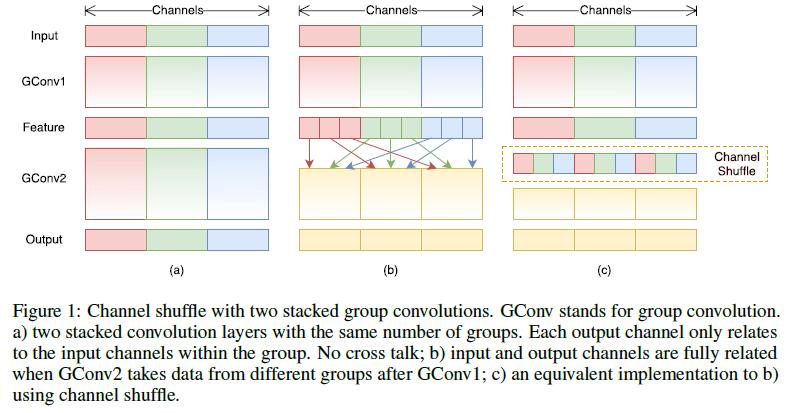
本质; 即进行GConv2之前,对其输入feature map做一个分配,使得GConv2的每一个group都能卷积输入的所有group的feature map
def _shuffle(x, groups):
    def shuffle_layer(x):
        _, w, h, n = K.int_shape(x)
        nb_chan_per_grp = n // groups

        x = K.reshape(x, (-1, w, h, nb_chan_per_grp, groups))
        x = K.permute_dimensions(x, (0, 1, 2, 4, 3)) # Transpose only grps and chs(按照给定的模式重排一个张量的轴)
        x = K.reshape(x, (-1, w, h, n)
        return x
附代码:
from keras.models import Model
from keras.layers import *
from keras.activations import *
from keras.callbacks import *
import keras.backend as K
from keras.engine.topology import get_source_inputs
count=0
def _info(groups):
    return {
        1: [24, 144, 288, 576],
        2: [24, 200, 400, 800],
        3: [24, 240, 480, 960],
        4: [24, 272, 544, 1088],
        8: [24, 384, 768, 1536]
    }[groups], [None, 3, 7, 3]


def basemodel(input_tensor=None, input_shape=None,groups=8):

    if input_tensor is None:
        img_input = Input(shape=input_shape)
    else:
        if not K.is_keras_tensor(input_tensor):
            img_input = Input(tensor=input_tensor, shape=input_shape)
        else:
            img_input = input_tensor

    bn_axis = 3 if K.image_data_format() == 'channels_last' else 1

    x = Conv2D(24,
               kernel_size=(3, 3),
               strides=2,
               use_bias=False,
               padding='same')(img_input)
    x = BatchNormalization()(x)
    x = Activation('relu')(x)
    x = MaxPooling2D(pool_size=(3, 3),
                     strides=2,
                     padding='same',)(x)
    x = Activation('relu',name='pool1')(x)


    channels_list, repeat_list = _info(groups)   #  [24, 200, 400, 800],[None, 3, 7, 3]
   # import pdb;pdb.set_trace()

    for i, (out_channels, repeat) in enumerate(zip(channels_list[1:], repeat_list[1:]), start=1):

        x = _stage(x, groups, channels_list[i-1], out_channels, repeat)


 #8
    if input_tensor is not None:
        inputs = get_source_inputs(input_tensor)
    else:
        inputs = img_input
    model = Model(inputs, x, name='basemodel_dense')

    return model


def _stage(tensor, groups, in_channels, out_channels, repeat):#repeat=repeat_list[1:],[None, 3, 7, 3]
    x = _shufflenet_unit(tensor, groups, in_channels, out_channels, 2) #2

    for _ in range(repeat):
        x = _shufflenet_unit(x, groups, out_channels, out_channels, 1)


    return x

#out_i=[4,12,16]
#(name='stage%s'% k[0])

def _pw_group(tensor, groups, in_channels, out_channels):      #一个组,分通道卷积操作,之后cancat
    """Pointwise grouped convolution."""
    nb_chan_per_grp = in_channels // groups

    pw_convs = []
    for grp in range(groups):
        x = Lambda(lambda x: x[:, :, :, nb_chan_per_grp * grp: nb_chan_per_grp * (grp + 1)])(tensor)
        grp_out_chan = int(out_channels / groups + 0.5)

        pw_convs.append(
            Conv2D(grp_out_chan,
                   kernel_size=(1, 1),
                   padding='same',
                   use_bias=False,
                   strides=1)(x)
        )

    return Concatenate(axis=-1)(pw_convs)


def _shuffle(x, groups):            #通道间的打乱
    def shuffle_layer(x):
        _, w, h, n = K.int_shape(x)
        nb_chan_per_grp = n // groups

        x = K.reshape(x, (-1, w, h, nb_chan_per_grp, groups))
        x = K.permute_dimensions(x, (0, 1, 2, 4, 3)) # Transpose only grps and chs(按照给定的模式重排一个张量的轴)
        x = K.reshape(x, (-1, w, h, n))

        return x

    return Lambda(shuffle_layer)(x)


def _shufflenet_unit(tensor, groups, in_channels, out_channels, strides, shuffle=True, bottleneck=4):
    bottleneck_channels = out_channels // bottleneck

    x = _pw_group(tensor, groups, in_channels, bottleneck_channels)   #深度可分离卷积
    x = BatchNormalization()(x)
    x = Activation('relu')(x)

    if shuffle:
        x = _shuffle(x, groups)         #通道间的打乱

    x = DepthwiseConv2D(kernel_size=(3, 3),             #深度卷积
                        padding='same',
                        use_bias=False,
                        strides=strides)(x)
    x = BatchNormalization()(x)


    x = _pw_group(x, groups, bottleneck_channels,
                  out_channels if strides < 2 else out_channels - in_channels)
    x = BatchNormalization()(x)

    if strides < 2:
        x = Add()([tensor, x])
    else:
        avg = AveragePooling2D(pool_size=(3, 3),
                               strides=2,
                               padding='same')(tensor)

        x = Concatenate(axis=-1)([avg, x])
    global count
    count+=1
    x = Activation('relu',name='stage%s'% count)(x)


    return x
发布者:全栈程序员-站长,转载请注明出处:https://javaforall.net/195795.html原文链接:https://javaforall.net




