
文章目录
1 概述
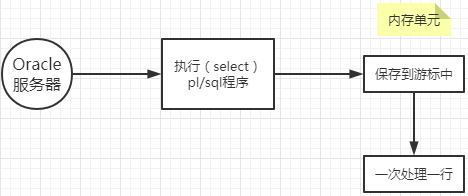
1. 游标是什么? 用来存储多条查询数据的一种数据结构('结果集'), 它有一个 '指针',从上往下移动('fetch'),从而能够 '遍历每条记录' 2. 优缺点 (1) 提高 sql '执行效率' (2) 牺牲 '内存' 游标概念图:

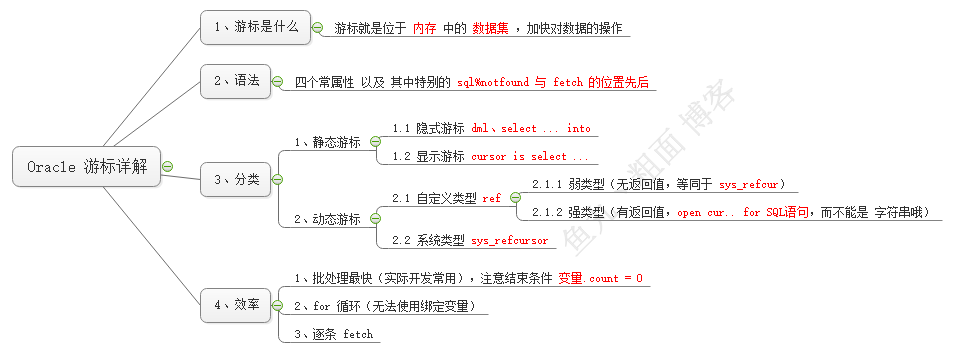
1.1 思维导图
2 语法
2.1 基本写法(4步)
-- 测试基础数据 create table stu_info ( id number(3), name varchar2(30), sex varchar2(2) ); insert into stu_info(id, name, sex) values (1, '小游子', '女'); insert into stu_info(id, name, sex) values (2, '小优子', '男'); commit; 游标语法:4 个步骤,获取 学生信息表(stu_info)的记录
declare -- 1 声明游标 cursor cur_stu_info is select * from stu_info; v_stu_info cur_stu_info%rowtype; begin -- 2 开启游标 open cur_stu_info; -- 3 获取数据(一次获取一行) fetch cur_stu_info into v_stu_info; dbms_output.put_line(v_stu_info.id || ' : ' || v_stu_info.name); -- 4 关闭游标 close cur_stu_info; end; 执行截图:
1 : 小游子 2.2 游标4大属性
属性 返回值类型 作用 sql%isopen 布尔型 判断游标是否 '开启' sql%found 布尔型 判断游标是否 '获取' 到值 sql%notfound 布尔型 判断游标是否 '没有获取' 到值(常用于 "退出循环") sql%rowcount 整型 '当前' 成功执行的数据行数(非 "总记录数") 特别说明:sql%notfound
Oracle 官方文档解释:
Before the first fetch%NOTFOUND returns NULL. If fetch never executes susscessfully. the loop is never exited, because then EXIT WHEN statement executes only if it’s WHEN condition is true. To be safe. you might want to use the following EXIT statement instead:
EXIT WHEN SQL%NOTFOUND OR SQL%NOTFOUND IS NULL;
简单说,退出循环的必要条件:fetch 语句执行成功 + 第一次 fetch 的值返回 null
-- -- 功能:循环读取数据 -- 核心:先后顺序 = 先 fetch ... 再 exit when *%notfound -- declare cursor cur_stu_info is select * from stu_info t where t.id = 9; v_stu_info cur_stu_info%rowtype; begin open cur_stu_info; loop fetch cur_stu_info into v_stu_info; -- 可测试,这段 fetch 放在 %notfound 后面 exit when cur_stu_info%notfound; dbms_output.put_line('该语句不会执行,因为没有 id = 9 的记录'); end loop; close cur_stu_info; end; 3 分类
3.1 静态游标
3.1.1 隐式游标 dml
1. 自动创建 (1) DML (2) select into 2. 自动管理 (1) 无需人为干预(自动声明、打开、关闭) (2) 默认游标名:'SQL' 演示:
declare v_count number; begin insert into stu_info (id, name, sex) values (3, '瑶瑶', '女'); if sql%found then dbms_output.put_line('插入成功!'); end if; update stu_info t set t.name = '悠悠' where t.id = 3; if sql%found then dbms_output.put_line('更新成功!'); end if; delete from stu_info t where t.id = 3; if sql%found then dbms_output.put_line('删除成功!'); end if; select count(1) into v_count from stu_info t; if sql%found then dbms_output.put_line('总记录为: ' || v_count); end if; if sql%isopen then dbms_output.put_line('不可能的,永远不可能走这一步'); else dbms_output.put_line('系统已自动关闭游标'); end if; end; 测试结果:
插入成功! 更新成功! 删除成功! 总记录为: 2 系统已自动关闭游标 3.1.2 显式游标 cursor
由关键字 cursor 声明,可带参数,也可不带参数 情况1:不带参数:同上 -> 游标语法:(4 个步骤)
情况2:带参数(声明参数值和类型):
declare v_stu_info stu_info%rowtype; -- 步骤1: 声明游标 cursor cur_stu_info(v_id stu_info.id%type) is select * from stu_info t where t.id = v_id; begin -- 步骤2: 打开游标 open cur_stu_info(1); -- 步骤3: 提取数据 fetch cur_stu_info into v_stu_info; dbms_output.put_line(v_stu_info.id || ' : ' || v_stu_info.name); -- 步骤4: 关闭游标 close cur_stu_info; end; 测试结果(都一样,因为都是取得 id=1 的记录):
1 : 小游子 3.2 动态游标
3.2.1 自定义类型 ref cursor
有两种使用情况 1. 弱类型,无 return(常用) 2. 强类型,有 return(游标的类型必须和 return 的类型完全一致) (1) '字段数量、字段类型、字段顺序' 均完全同 return 一致 (2) 此时 open ... for 后只能用 sql 语句,而不能是 '字符串' 情况1:弱类型,无 return(常用)
declare v_sql_select varchar(200); v_id scott.stu_info.id%type; v_name scott.stu_info.name%type; type cur_stu_type is ref cursor; -- 无 return cur_stu_info cur_stu_type; begin -- 测试 v_id := 1; v_sql_select := 'SELECT t.id, t.name FROM stu_info t WHERE t.id <= :b1'; open cur_stu_info for v_sql_select using v_id; -- 绑定变量(大数据处理常用优化手段) fetch cur_stu_info into v_id, v_name; dbms_output.put_line(v_id || ' :' || v_name); close cur_stu_info; end; 输出结果:
1 :小游子 情况2:强类型,有 return
declare v_sql_select varchar(200); v_stu_info_rows scott.stu_info%rowtype; type cur_stu_type is ref cursor return scott.stu_info%rowtype; -- 有 return cur_stu_info cur_stu_type; begin -- 测试 /* v_id := 1; v_sql_select := 'SELECT t.id, t.name FROM stu_info t WHERE t.id <= :b1';*/ open cur_stu_info for select t.id, t.name, t.sex from stu_info t; fetch cur_stu_info into v_stu_info_rows; dbms_output.put_line(v_stu_info_rows.id || ' :' || v_stu_info_rows.name); close cur_stu_info; end; 输出结果:(同弱类型一样)
1 :小游子 3.2.2 系统类型 sys_refcursor
常用,省去了手动定义动态游标的步骤,以下效果等同:
declare -- type cur_stu_type is ref cursor; -- 手动定义动态游标 -- cur_stu_info cur_stu_type; -- 声明动态游标, 这一个步骤等于上面两个步骤 cur_stu_info sys_refcursor; begin end; 4 扩展
4.1 三种游标循环效率对比
结论:一般来说 '批量处理' 的速度要最好,'隐式游标' 的次之,'单条处理' 的最差 说明:若有兴趣,可以在数据量多的表里面,分别尝试下列三种写法,并打印时间,用作比较 1. 批量处理 open 游标; loop fetch 游标 bulk collect into 集合变量(也就是 table 类型哦) limit 数值; -- 一般 500 左右 exit when 条件; -- cursor.count = 0 逻辑处理; end loop; close 游标; 2. 隐式游标 for x in (sql 语句) loop 逻辑处理; end loop; 3. 单条处理 open 游标; loop fetch 游标 into 变量; exit when 条件; 逻辑处理; end loop; close 游标; 4.2 实例:实际开发中,游标遍历数据
-- * -- 功能:读取表 stu_info 数据 -- * declare v_sql_select varchar(300); cur_stu_info sys_refcursor; type record_stu_info is record( v_id scott.stu_info.id%type, v_name scott.stu_info.name%type); type table_stu_info is table of record_stu_info; v_stu_info_table table_stu_info; begin v_sql_select := 'SELECT t.id, t.name FROM stu_info t WHERE t.id <= :b1'; open cur_stu_info for v_sql_select using 3; -- 绑定变量,此处 3,仅用作测试 loop fetch cur_stu_info bulk collect into v_stu_info_table limit 1; -- 数据量太少,仅当前测试使用哦,实际开发 建议 500 左右 -- 此时 %notfound 不合适,count 适用 -- 因为 可能找到数据了(found 非空值),但是小于 limit n exit when v_stu_info_table.count = 0; -- 退出条件! for i in v_stu_info_table.first .. v_stu_info_table.last loop dbms_output.put_line('序号:' || v_stu_info_table(i).v_id || ' , ' || '姓名:' || v_stu_info_table(i).v_name); end loop; end loop; close cur_stu_info; exception when others then -- 异常时,仍要 关闭游标 if cur_stu_info%isopen then close cur_stu_info; end if; dbms_output.put_line(sqlcode || ' : ' || sqlerrm); dbms_output.put_line(dbms_utility.format_error_backtrace); end; 测试结果:(建议在 ‘测试窗口’ debug 看看执行步骤)
序号:1 , 姓名:小游子 序号:2 , 姓名:小优子 版权声明:本文内容由互联网用户自发贡献,该文观点仅代表作者本人。本站仅提供信息存储空间服务,不拥有所有权,不承担相关法律责任。如发现本站有涉嫌侵权/违法违规的内容, 请联系我们举报,一经查实,本站将立刻删除。
发布者:全栈程序员-站长,转载请注明出处:https://javaforall.net/198927.html原文链接:https://javaforall.net


![连云港[通俗易懂]](https://javaforall.net/wp-content/uploads/2020/11/2020110817443450-480x300.jpg)

