
一、官方文档介绍
二、torch.nn.Conv2d()函数详解
参数详解
torch.nn.Conv2d(in_channels, out_channels, kernel_size, stride=1, padding=0, dilation=1, groups=1, bias=True)
| 参数 | 参数类型 | ||
|---|---|---|---|
in_channels |
int | Number of channels in the input image | 输入图像通道数 |
out_channels |
int | Number of channels produced by the convolution | 卷积产生的通道数 |
kernel_size |
(int or tuple) | Size of the convolving kernel | 卷积核尺寸,可以设为1个int型数或者一个(int, int)型的元组。例如(2,3)是高2宽3卷积核 |
stride |
(int or tuple, optional) | Stride of the convolution. Default: 1 | 卷积步长,默认为1。可以设为1个int型数或者一个(int, int)型的元组。 |
padding |
(int or tuple, optional) | Zero-padding added to both sides of the input. Default: 0 | 填充操作,控制padding_mode的数目。 |
padding_mode |
(string, optional) | ‘zeros’, ‘reflect’, ‘replicate’ or ‘circular’. Default: ‘zeros’ | padding模式,默认为Zero-padding 。 |
dilation |
(int or tuple, optional) | Spacing between kernel elements. Default: 1 | 扩张操作:控制kernel点(卷积核点)的间距,默认值:1。 |
groups |
(int, optional) | Number of blocked connections from input channels to output channels. Default: 1 | group参数的作用是控制分组卷积,默认不分组,为1组。 |
bias |
(bool, optional) | If True, adds a learnable bias to the output. Default: True | 为真,则在输出中添加一个可学习的偏差。默认:True。 |
参数dilation——扩张卷积(也叫空洞卷积)
参数groups——分组卷积
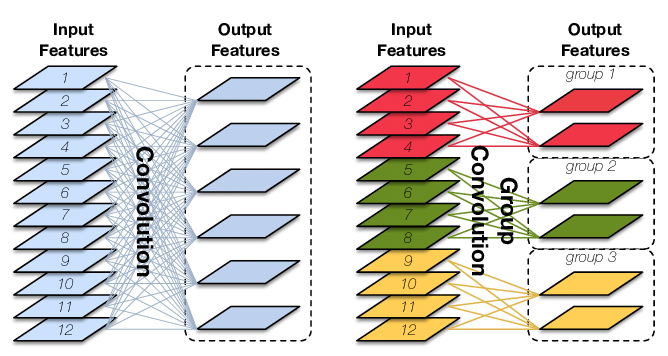
Group Convolution顾名思义,则是对输入feature map进行分组,然后每组分别卷积。
假设输入feature map的尺寸仍为 C ∗ H ∗ W C * H * W C∗H∗W,输出feature map的数量为 N N N个,如果设定要分成 G G G个groups,则每组的输入feature map数量为 C G \frac{C}{G} GC,每组的输出feature map数量为 N G \frac{N}{G} GN,每个卷积核的尺寸为 C G ∗ K ∗ K \frac{C}{G} * K * K GC∗K∗K,卷积核的总数仍为 N N N个,每组的卷积核数量为 N G \frac{N}{G} GN,卷积核只与其同组的输入map进行卷积,卷积核的总参数量为 N ∗ C G ∗ K ∗ K N * \frac{C}{G} * K * K N∗GC∗K∗K,可见,总参数量减少为原来的 1 G \frac{1}{G} G1,其连接方式如下图右所示,group1输出map数为2,有2个卷积核,每个卷积核的channel数为4,与group1的输入map的channel数相同,卷积核只与同组的输入map卷积,而不与其他组的输入map卷积。

三、代码实例
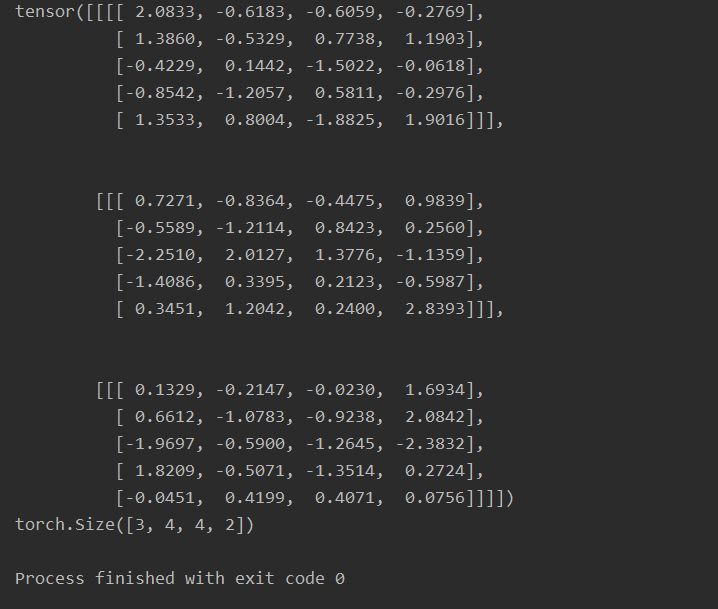
import torch x = torch.randn(3,1,5,4) print(x) conv = torch.nn.Conv2d(1,4,(2,3)) res = conv(x) print(res.shape) # torch.Size([3, 4, 4, 2]) 输入:x[ batch_size, channels, height_1, width_1 ]
batch_size,一个batch中样本的个数 3
channels,通道数,也就是当前层的深度 1
height_1, 图片的高 5
width_1, 图片的宽 4
卷积操作:Conv2d[ channels, output, height_2, width_2 ]
channels,通道数,和上面保持一致,也就是当前层的深度 1
output ,输出的深度 4【需要4个filter】
height_2,卷积核的高 2
width_2,卷积核的宽 3
输出:res[ batch_size,output, height_3, width_3 ]
batch_size,,一个batch中样例的个数,同上 3
output, 输出的深度 4
height_3, 卷积结果的高度 4
width_3,卷积结果的宽度 2
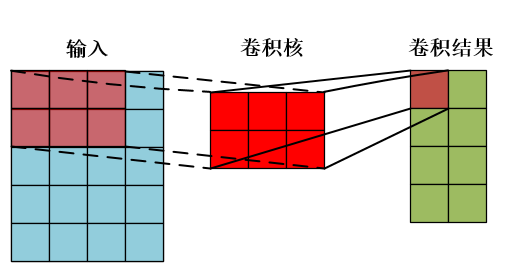
一个样本卷积示例:
发布者:全栈程序员-站长,转载请注明出处:https://javaforall.net/201967.html原文链接:https://javaforall.net