
always@(posedge clk) begin if(ce == 1'b1 && ready == 1'b1) w_en <= 1'b1; else w_en <= 1'b0; end 情形二:
always@(posedge clk) begin if(ce == 1'b1 && ready == 1'b1) if(data <= 8'b1111_1111) data <= data_in; else data <= data; //data_in是上一个模块的时序输出 end 情形一: 首先,进入这个过程块的条件是在时序的上升沿,如果满足if条件就会执行 w_en <= 1'b1; 赋值过程是这样的,首先统一计算表达式右边的值,然后在统一的赋给左边的变量,改变是几乎 是立即发生的,也就是在本周期改变。w_en <= 1'b1 语句右边的值可以看做是一个组合逻辑 信号,所以改变是立即发生的。 情形二: 首先,进入这个过程块的条件也是在时序的上升沿,如果满足if条件就会进入到data<= data_in,否则保持不变。赋值的过程也是先统一计算表达式右边的值,然后在一次性赋给表达 左边的变量data,改变也几乎是立即的,即也是在本周期进行更新。由于data_in是有外部的模 块传输进来的,所以需要看一下data_in是否经过时序驱动,如果经过时序驱动,那data_in就 相当于一个时序逻辑信号,所以data肯定会比data_in晚一个周期。如果data_in是一个组合逻辑信号,那么data和data_in的波形在条件满足之后就会完全对齐。 请看下面的这个式子: always@(posedge clk)begin if(条件满足) begin b <= a; end else begin …… end end 如果把 a换成data_in,把b换成data可能会更好理解一点。 附录:
顶层模块:
module non_block( input clk, input rst, input ce, input ready, input [7:0] data_in, output reg w_en, output reg [7:0] data ); reg [7:0] data_reg = 8'b0; always@(posedge clk)begin if(!rst)begin w_en <= 1'b0; data <= 8'b0; end else if(ce ==1'b1 && ready ==1'b1) begin if(data<=8'b)begin w_en <= 1'b1; data <= data_in; end end end endmodule tb1:
module tb_non_block( ); reg clk; reg rst; reg ce; reg ready; reg [7:0] data_in; wire w_en; wire [7:0] data; initial begin clk = 1; forever #10 begin clk = ~clk; end end initial begin rst = 0; ce =0; ready = 0; #60; rst = 1; #20; ce = 1'b1; ready = 1'b1; end //data_in是一个时序逻辑信号 always@(posedge clk)begin if(!rst) data_in <=0; else if(data_in<=8'b) data_in <= data_in +1; end non_block non_block0( .clk(clk), .rst(rst), .ce(ce), .ready(ready), .data_in(data_in), .w_en(w_en), .data(data) ); endmodule 对应的波形如下:
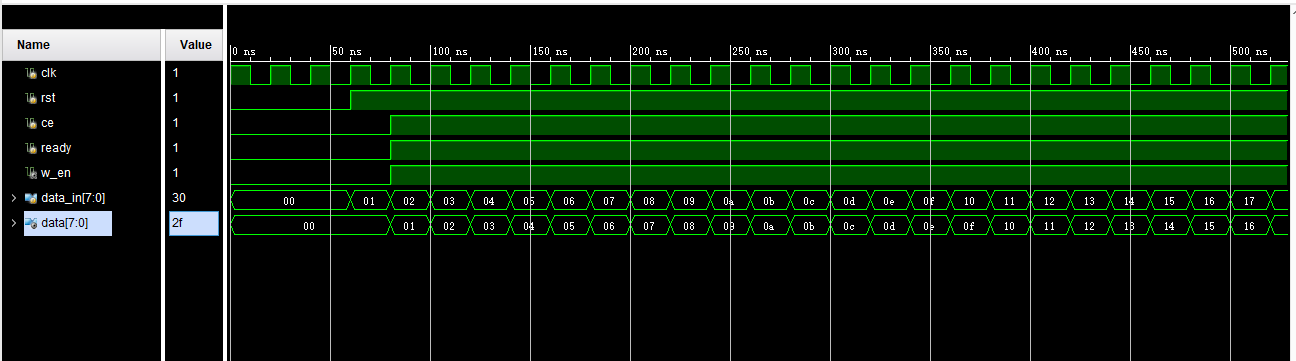

tb2:
module tb_non_block( ); reg clk; reg rst; reg ce; reg ready; reg [7:0] data_in; wire w_en; wire [7:0] data; initial begin clk = 1; forever #10 begin clk = ~clk; end end initial begin rst = 0; ce =0; ready = 0; data_in = 8'b0; #60; rst = 1; #20; ce = 1'b1; ready = 1'b1; data_in = 8'b00010001; //data_in是一个组合逻辑信号 end non_block non_block0( .clk(clk), .rst(rst), .ce(ce), .ready(ready), .data_in(data_in), .w_en(w_en), .data(data) ); endmodule 版权声明:本文内容由互联网用户自发贡献,该文观点仅代表作者本人。本站仅提供信息存储空间服务,不拥有所有权,不承担相关法律责任。如发现本站有涉嫌侵权/违法违规的内容, 请联系我们举报,一经查实,本站将立刻删除。
发布者:全栈程序员-站长,转载请注明出处:https://javaforall.net/205166.html原文链接:https://javaforall.net



