
今天学习了第三种图像缩放的方法,双三次插值法。由于理解能力比较差,看了好久的公式,还是云里雾里,但是为了督促自己学习,还是把已知的部分记录下来。
数学原理
维基百科的解释

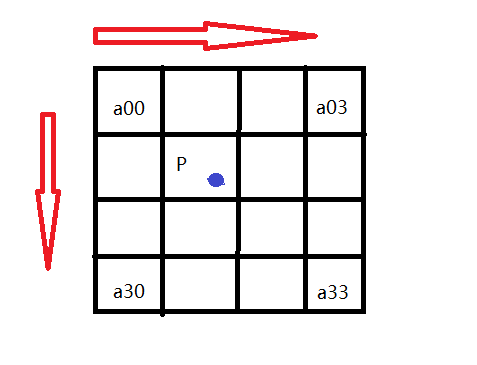
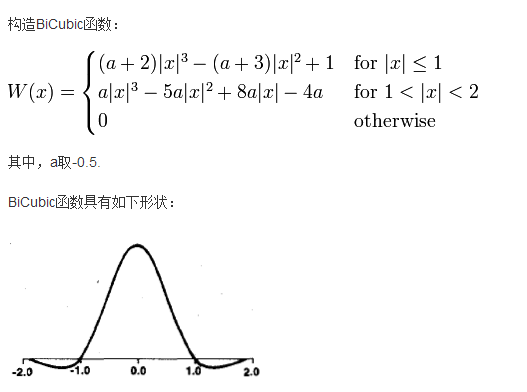
参考这里的博客
k_i_0=W(1+u), k_i_1=W(u), k__i_2=W(1-u), k_i_3=W(2-u);
k_j_0=W(1+v), k_j_1=W(v), k_j_2=W(1-v), k_j_3=W(2-v);
程序实现
/10-9* 功能:双三次插值缩放图片 数学原理:假设原图像A的大小为m*n,新图像B的大小为M*N 如果我们要求B(X,Y)处的像素值: 我们首先可以得到B(X,Y)在图像A中对应的位置(x,y)=(X*(m/M),Y*(N/n)) 这个时候求得的x,y是小数值,我们可以通过这个小数值坐标找到距离最近的16个像素点, 利用所选择的基函数,求出对应的每个像素的权值,最终获得pixelB(X,Y) / #include
(
int(x) + s -
1,
int(y) + t -
1))*w_x[s] * w_y[t]; } } biggerImage.at
(i, j) = (Vec3b)temp; } } imshow(
"image", image); imshow(
"biggerImage", biggerImage); waitKey(
0);
return
0; }
/*计算系数*/
void getW_x(
float w_x[
4],
float x){
int X = (
int)x;
//取整数部分
float stemp_x[
4]; stemp_x[
0] =
1 + (x - X); stemp_x[
1] = x - X; stemp_x[
2] =
1 - (x - X); stemp_x[
3] =
2 - (x - X); w_x[
0] = a*
abs(stemp_x[
0] * stemp_x[
0] * stemp_x[
0]) -
5 * a*stemp_x[
0] * stemp_x[
0] +
8 * a*
abs(stemp_x[
0]) -
4 * a; w_x[
1] = (a +
2)*
abs(stemp_x[
1] * stemp_x[
1] * stemp_x[
1]) - (a +
3)*stemp_x[
1] * stemp_x[
1] +
1; w_x[
2] = (a +
2)*
abs(stemp_x[
2] * stemp_x[
2] * stemp_x[
2]) - (a +
3)*stemp_x[
2] * stemp_x[
2] +
1; w_x[
3] = a*
abs(stemp_x[
3] * stemp_x[
3] * stemp_x[
3]) -
5 * a*stemp_x[
3] * stemp_x[
3] +
8 * a*
abs(stemp_x[
3]) -
4 * a; }
void getW_y(
float w_y[
4],
float y){
int Y = (
int)y;
float stemp_y[
4]; stemp_y[
0] =
1.0 + (y - Y); stemp_y[
1] = y - Y; stemp_y[
2] =
1 - (y - Y); stemp_y[
3] =
2 - (y - Y); w_y[
0] = a*
abs(stemp_y[
0] * stemp_y[
0] * stemp_y[
0]) -
5 * a*stemp_y[
0] * stemp_y[
0] +
8 * a*
abs(stemp_y[
0]) -
4 * a; w_y[
1] = (a +
2)*
abs(stemp_y[
1] * stemp_y[
1] * stemp_y[
1]) - (a +
3)*stemp_y[
1] * stemp_y[
1] +
1; w_y[
2] = (a +
2)*
abs(stemp_y[
2] * stemp_y[
2] * stemp_y[
2]) - (a +
3)*stemp_y[
2] * stemp_y[
2] +
1; w_y[
3] = a*
abs(stemp_y[
3] * stemp_y[
3] * stemp_y[
3]) -
5 * a*stemp_y[
3] * stemp_y[
3] +
8 * a*
abs(stemp_y[
3]) -
4 * a; }
注:由于作者编程能力有限,希望有人能指正一下怎么优化这里的程序,这个程序只是实现了算法,运行
速度慢的要死不能忍受!
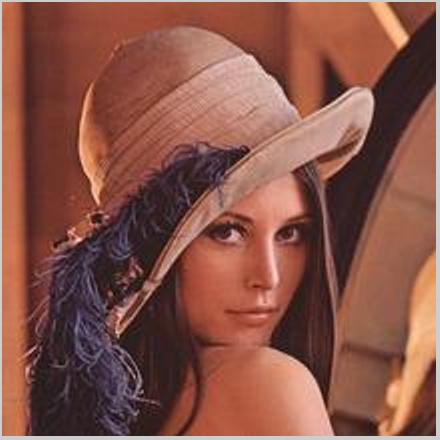
效果展示

版权声明:本文内容由互联网用户自发贡献,该文观点仅代表作者本人。本站仅提供信息存储空间服务,不拥有所有权,不承担相关法律责任。如发现本站有涉嫌侵权/违法违规的内容, 请联系我们举报,一经查实,本站将立刻删除。
发布者:全栈程序员-站长,转载请注明出处:https://javaforall.net/215356.html原文链接:https://javaforall.net




