
大家好,又见面了,我是你们的朋友全栈君。
同underscore.js库一样,prototypejs也提供了丰富的工具方法来操作javascript内置对象(Array,Function,Object)等。工具方法不做过多介绍,自己去看就好,这里主要关注下prototypejs继承的实现机制。我使用的是prototype-1.7.3.js,我们看一段有趣的代码:
var Animal = Class.create({
      initialize: function(name, sound) {
        this.name  = name;
        this.sound = sound;
      },

      speak: function() {
        console.log("in Animal="+this.name + " says: " + this.sound + "!");
      }
    });

var Dog = Class.create(Animal, {
	initialize: function($super, name) {
		$super(name, 'dog-sound');
	},
	speak: function($super){
		$super();
		console.log("Haha in Dog.");
	}
});

var oneDog = new Dog("aty's dog");
oneDog.speak();
// output:
// in Animal=aty's dog says: dog-sound!
// Haha in Dog.
是不是和java中的继承有点像,我们居然可以使用$super来调用父类中的方法。不过有些差别:java中可以使用super调用父类中的任何公开的方法,但是在prototypejs里面$super只是一个方法,不是父对象。我们先研究下,prototypejs是如何做到$super,后面再看我们能不能改造它,让$super更像java中的super关键字。
简单说下prototypejs中的Object.extend(),功能其实和jQuery库中的$.extend(),underscore库_.extend()功能很类似,用来将一个对象上的属性和方法拷贝到另一个对象上。只不过jQuery将extend函数挂在了$对象上,underscore将extend挂在了_对象上,而prototypejs则将它挂在了Object对象上,这些类库都没有修改js内置函数的原型。看下prototypejs中object.js的注释:
 Because it is dangerous and invasive to augment `Object.prototype` (i.e.,
 add instance methods to objects), all these methods are static methods that
 take an [[Object]] as their first parameter.
知乎上的这篇文章讨论了“为什么不要直接在Object.prototype上定义方法?”。所以prototypejs也并没有修改Object.prototype,而是将Object相关的方法挂在了Object函数上。我们知道javascript中函数其实也是对象,也能添加自定义的方法或者属性。下面这段代码是完全正确的,prototypejs库也是采用了类似的方法,扩展了Object(这个既是函数,又是对象的东西)。
Object.plus = function(a,b){return a + b;};
Object.owner = "aty";
alert(Object.owner);
alert(Object.plus(1,2));
下面我们来看下Class.create()这个API的使用,主要是看懂API文档中的三段话:
第一段:
Class.create creates a class and returns a constructor function for instances of the class. Calling the constructor function (typically as part of a new statement) will invoke the class's initialize method.这个so easy,不过还是补充一段代码一看就懂了。
var Base = Class.create({
	initialize : function(){
		console.log("i will be invoked when call new Base");
		for(var i = 0; i<arguments.length;i++)
		{
			console.log((i+1)+ " param="+arguments[i]);
		}

	}
});

new Base("a",1);
第二段:这个主要介绍create()函数参数的,有点复杂,我们慢慢分解。
Class.create accepts two kinds of arguments. If the first argument is a Class, it's used as the new class's superclass, and all its methods are inherited. Otherwise, any arguments passed are treated as objects, and their methods are copied over ("mixed in") as instance methods of the new class.
先看下面这段代码,会报错:Uncaught TypeError: Cannot read property ‘push’ of undefined。
// javascript中所谓的类就是函数
function MyParent(id)
{
	this.id = id;
}

MyParent.funcA = function(){
	console.log("funcA in object");
}

MyParent.prototype.funcB = function(){
	console.log("funcA in prototype");
}

var MyChild = Class.create(MyParent,{
	funcC : function(name){
		console.log("");
	}
});
我们自己创建了一个javascript类MyParent,希望用Class.create()实现继承,但是prototypejs却报错了。我们看class.js的一段源代码:
 function create() {
    var parent = null, properties = $A(arguments);
	//判断第一个参数是否是函数(也就是类)
    if (Object.isFunction(properties[0]))
      parent = properties.shift();

    function klass() {
      this.initialize.apply(this, arguments);
    }

    Object.extend(klass, Class.Methods);
    klass.superclass = parent;
    klass.subclasses = [];

	// 如果第一个参数是函数,会直接读取subclasses等属性
    if (parent) {
      subclass.prototype = parent.prototype;
      klass.prototype = new subclass;
      parent.subclasses.push(klass);
    }
	......
}很显然第一个参数是函数,那么prototypejs就会读取它的subclasses等属性。很显然我们自定义的函数是没有subclasses属性的,而Class.create()返回的函数是有这些属性的。这提示我们:create()第一个参数如果是函数,那么必须要是Class.create()返回的函数,不能是我们自定义的函数。比如下面这段代码就不会报错了:
// create的第一个参数不是函数
var MyBase = Class.create({
		hi:function(){console.log("hi");}
	});

// 第一参数是Class.create()的返回值
var MyChild = Class.create(MyBase,{
		funcC : function(name){
			console.log("right");
		}
});

new MyChild().hi();
new MyChild().funcC();
我们再看一下create()第一个参数是objec时,会有什么效果。
var obj = {};

var AfterMixIn = Class.create(obj, {id:"123",name:"aty"},{
	funcC : function(name){
		console.log("name="+name);
	}
});

console.log(obj.id);//undefined

var newObject = new AfterMixIn();

newObject.funcC("aty");//name=aty

console.log("id=" + newObject.id);//id=123

//error: afterMixIn.funcC is not a function
AfterMixIn.funcC("aty");输出结果已经放在上面的代码注释里了,可以看到:create()并不会修改第一个参数obj,而是返回了一个新函数(prototypejs中的类)AfterMixIn。类AfterMixIn(既是javascript中的函数,也是对象)本身并没有增加属性id、name和方法funcC,必需通过创建AfterMixIn类的对象来访问这些属性和方法。
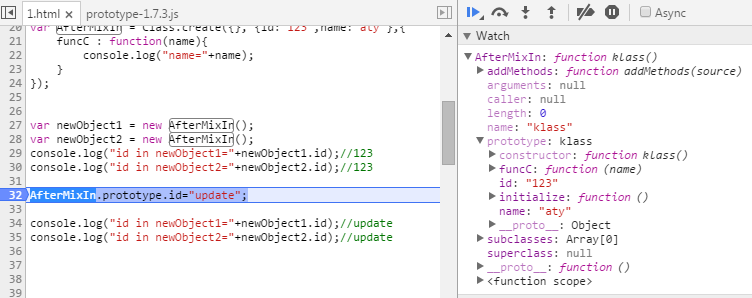
上面这段代码稍微修改下,在chrome下debug,可以看到这些新增的id、name、funcC其实是存储在AfterMixIn这个函数的原型中的。
var AfterMixIn = Class.create({}, {id:"123",name:"aty"},{
	funcC : function(name){
		console.log("name="+name);
	}
});

var newObject1 = new AfterMixIn();
var newObject2 = new AfterMixIn();
console.log("id in newObject1="+newObject1.id);//123
console.log("id in newObject2="+newObject2.id);//123

AfterMixIn.prototype.id="update";

console.log("id in newObject1="+newObject1.id);//update
console.log("id in newObject2="+newObject2.id);//update
第三段:主要讲$super怎么使用的,本文刚开始的代码就使用了$super,这个很容易不再赘述。
If a subclass overrides an instance method declared in a superclass, the subclass's method can still access the original method. To do so, declare the subclass's method as normal, but insert $super as the first argument. This makes $super available as a method for use within the function.
我们接着看下Class#addMethods()这个API的使用,它的功能很简单“To extend a class after it has been defined”。
var Animal = Class.create({
	initialize:function(name){
		this.name = name;
	}

});

var Person = Class.create(Animal,{
	say : function(msg){
		console.log(this.name + " say '" + msg + "'!");
	}
});


var po = new Person("aty");

Person.addMethods({
	smile : function(msg){
		console.log(this.name + " smile '" + msg + "'!");
	}
});

Person.prototype.anotherSmile = function(msg){
	console.log(this.name + " anotherSmile '" + msg + "'!");
}

po.smile("learn is happy.");
po.anotherSmile("learn is happy.");
简单吧,Class#addMethods()其实就是将方法加入到了函数的原型中,被该构造函数创建的所有对象共享。
至此应该知道怎么使用Object.extend()、Class.create()、Class#addMethods()了。现在看官方的“Defining classes and inheritance”这篇tutorial文章应该不陌生了。
tutorial里面还提到了一个问题,需要关注:
var Logger = Class.create({
	  initialize: function() { },
	  log: [],
	  write: function(message) {
		this.log.push(message);
	  }
});

var logger = new Logger;
logger.write('foo');
logger.write('bar');


var another = new Logger();
console.log(another.log);//["foo", "bar"]
我们知道这些属性和方法都是放在javascript函数的prototype中的,会被构造函数创建的所有对象共享。由于javascript中原型读写的不对等性,会导致js也区分基本数据类型和引用数据类型。和上面代码类似,下面这段代码就不会有问题,不同Logger对象的count么有影响。
var Logger = Class.create({
  initialize: function() { },
  count: 0,
  write: function(message) {
    this.log.push(message);
  }
});

var logger = new Logger;
logger.count++;
logger.count++;
console.log(logger.count);//2

var another = new Logger();
console.log(another.count);//0
如果你对于javascript原型的读写不等性、原型的copy-on-write不太理解,可以看下我的另外2篇文章。
javascript原型的修改与重写(覆盖)差别
javascript读取和修改原型特别需要注意的事儿,因为原型的读写不具有对等性
发布者:全栈程序员-站长,转载请注明出处:https://javaforall.net/163399.html原文链接:https://javaforall.net