

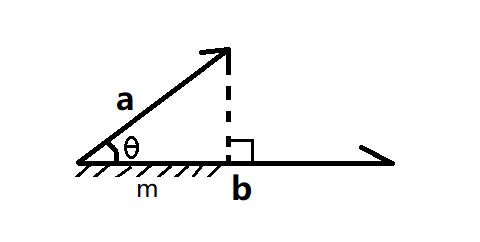
点积(数量积,内积)

向量 a a 在向量
由 a⋅b a ⋅ b 与 0 0 的大小关系可以判断出
如果 a⋅b=0 a ⋅ b = 0 ,则 ∠θ=90ο ∠ θ = 90 ο
如果 a⋅b>0 a ⋅ b > 0 ,则 ∠θ<90ο ∠ θ < 90 ο
如果 a⋅b<0 a ⋅ b < 0 ,则 ∠θ>90ο ∠ θ > 90 ο
当然需要特殊考虑向量共线的情况,也就是 ∠θ=0οor180ο ∠ θ = 0 ο o r 180 ο (这个可以用叉积来判断)
叉积(向量积,外积)

叉积有很广泛的用法
- 极角排序
- 凸包
- 判断直线是否相交(跨立实验)
- 求三角形以及多边形的面积
板子~
#include
#include
#include
#include
#include
#include
#include
#include
#include
#include #include
#include
#include
#include
#include
#include
#include
#include
#include
#include
#include
#include
typedef long long LL; #define for_each(it, container) for(__typeof(container.begin()) it = container.begin(); it != container.end(); ++it) #define mp std::make_pair #define pii std::pair
#define sqr(x) ((x) * (x)) const double eps = 1e-8; int sgn(double x) { return x < -eps ? -1 : x > eps; } struct Point; typedef Point Vector; struct Point { double x, y; void in() { scanf("%lf%lf", &x, &y); } void print() { printf("%.2lf %.2lf\n", x, y); } Point(double x = 0, double y = 0) : x(x), y(y) { } inline Vector rotate(double ang) { return Vector(x * cos(ang) - y * sin(ang), x * sin(ang) + y * cos(ang)); } inline double dot(const Vector &a) { return x * a.x + y * a.y; } inline bool operator == (const Point &a) const { return sgn(x - a.x) == 0 && sgn(y - a.y) == 0; } inline bool operator < (const Point &a) const { return sgn(x - a.x) < 0 || sgn(x - a.x) == 0 && sgn(y - a.y) < 0; } inline Vector operator + (const Vector &a) const { return Vector(x + a.x, y + a.y); } inline Vector operator - (const Vector &a) const { return Vector(x - a.x, y - a.y); } inline double operator * (const Vector &a) const { return x * a.y - y * a.x; } inline Vector operator * (double t) const { return Vector(x * t, y * t); } inline Vector operator / (double t) { return Vector(x / t, y / t); } inline double vlen() { return sqrt(x * x + y * y); } inline Vector norm() { return Point(-y, x); } }; struct Cir { Point ct; double r; void in() { ct.in(); scanf("%lf", &r); } }; struct Seg { Point s, e; Seg() { } Seg(Point s, Point e): s(s), e(e) { } void in() { s.in(); e.in(); } }; struct Line { int a, b, c; }; inline bool cmpyx(const Point &a, const Point &b) { if(a.y != b.y) { return a.y < b.y; } return a.x < b.x; } double cross(Point a, Point b, Point c) { return (b.x - a.x) * (c.y - a.y) - (c.x - a.x) * (b.y - a.y); } bool same_dir(Vector a, Vector b) { return sgn(a.x * b.y - b.x * a.y) == 0 && sgn(a.x * b.x) >= 0 && sgn(a.y * b.y) >= 0; } bool dot_on_seg(Point p, Seg L) { return sgn((L.s - p) * (L.e - p)) == 0 && sgn((L.s - p).dot(L.e - p)) <= 0; } double ppdis(Point a, Point b) { return sqrt((a - b).dot(a - b)); } double pldis(Point p,Point l1,Point l2) { return fabs(cross(p,l1,l2))/ppdis(l1,l2); } double pldis(Point p, Line ln) { return fabs(ln.a * p.x + ln.b * p.y + ln.c) / sqrt(ln.a * ln.a + ln.b * ln.b); } bool point_in_circle(Point &a, Cir cr) { return sgn(ppdis(a, cr.ct) - cr.r) <= 0; } bool intersect(Point P, Vector v, Point Q, Vector w, Point &ret) { Vector u = P - Q; if(sgn(v * w) == 0) return false; double t = w * u / (v * w); ret = P + v * t; return true; } Point intersect(Point P, Vector v, Point Q, Vector w) { Point ret; Vector u = P - Q; if(sgn(v * w) == 0) return false; double t = w * u / (v * w); ret = P + v * t; return ret; } //点到直线距离 Point disptoline(Point p, Seg l) { return fabs(cross(p, l.s, l.e)) / ppdis(l.s, l.e); } //点到直线的垂足(最近点) Point ptoline(Point p, Seg l) { Point vec = l.s - l.e; return intersect(p, vec.norm(), l.s, vec); } //点到线段的最近点 Point ptoseg(Point p, Seg l) { Point norm = (l.s - l.e).norm(); if(sgn(norm * (p - l.s)) * sgn(norm * (p - l.e)) > 0) { double sa = ppdis(p, l.s); double sb = ppdis(p, l.e); return sgn(sa - sb) < 0 ? l.s : l.e; } return intersect(p, norm, l.s, l.e - l.s); } bool segcross(Point p1, Point p2, Point q1, Point q2) { return ( std::min(p1.x, p2.x) <= std::max(q1.x, q2.x) && std::min(q1.x, q2.x) <= std::max(p1.x, p2.x) && std::min(p1.y, p2.y) <= std::max(q1.y, q2.y) && std::min(q1.y, q2.y) <= std::max(p1.y, p2.y) && /* 跨立实验 */ cross(p1, q2, q1) * cross(p2, q2, q1) <= 0 && cross(q1, p2, p1) * cross(q2, p2, p1) <= 0 /* 叉积相乘判方向 */ ); } // 水平序, 注意两倍空间 struct Convex_Hull { static const int N = ; Point p[2 * N]; int n; void init() { n = 0; } void in() { p[n].in(); n++; } inline void push_back(const Point &np) { p[n++] = np; } void gao() { if(n < 3) { return ; } std::sort(p, p + n); std::copy(p, p + n - 1, p + n); std::reverse(p + n, p + 2 * n - 1); int m = 0, top = 0; for(int i = 0; i < 2 * n - 1; i++) { while(top >= m + 2 && sgn((p[top - 1] - p[top - 2]) * (p[i] - p[top - 2])) <= 0) { top --; } p[top++] = p[i]; if(i == n - 1) { m = top - 1; } } n = top - 1; } void print() { for(int i = 0; i < n; i++) { p[i].print(); } } double get_area() { double ret = 0; Point ori(0, 0); for(int i = 0; i < n; i++) { ret += (p[i] - ori) * (p[i + 1] - ori); } return fabs(ret) / 2; } double rotate() { if(n == 2) { return (p[0] - p[1]).dot(p[0] - p[1]); } int i = 0, j = 0; for(int k = 0; k < n; k++) { if(!(p[k] < p[i])) i = k; if(!(p[j] < p[k])) j = k; } double ret = 0; int si = i, sj = j; while(i != sj || j != si) { ret = std::max(ret, (p[i]-p[j]).dot(p[i]-p[j])); if(sgn ( (p[(i + 1) % n] - p[i]) * (p[(j + 1) % n] - p[j]) ) < 0) { i = (i + 1) % n; } else { j = (j + 1) % n; } } return ret; } bool in_convex(Point pt) { if(sgn((p[1]-p[0])*(pt-p[0])) <= 0 || sgn((p[n-1]-p[0])*(pt-p[0])) >= 0) { return false; } int l = 1, r = n - 2, best = -1; while(l <= r) { int mid = l + r >> 1; int f = sgn((p[mid]-p[0])*(pt-p[0])); if(f >= 0) { best = mid; l = mid + 1; } else { r = mid - 1; } } return sgn((p[best+1]-p[best])*(pt-p[best])) > 0; } }convex; Line turn(Point s, Point e) { Line ln; ln.a = s.y - e.y; ln.b = e.x - s.x; ln.c = s.x * e.y - e.x * s.y; return ln; } //圆的折射,输入圆心,p->inter是射线,inter是圆上一点, ref是折射率,返回折射向量 Vector reflect_vector(Point center, Point p, Point inter, double ref) { Vector p1 = inter - p, p2 = center - inter; double sinang = p1 * p2 / (p1.vlen() * p2.vlen()) / ref; double ang = asin(fabs(sinang)); return sinang > eps ? p2.rotate(-ang) : p2.rotate(ang); } bool cir_line(Point ct, double r, Point l1, Point l2, Point& p1, Point& p2) { if ( sgn (pldis(ct, l1, l2) - r ) > 0) return false; double a1, a2, b1, b2, A, B, C, t1, t2; a1 = l2.x - l1.x; a2 = l2.y - l1.y; b1 = l1.x - ct.x; b2 = l1.y - ct.y; A = a1 * a1 + a2 * a2; B = (a1 * b1 + a2 * b2) * 2; C = b1 * b1 + b2 * b2 - r * r; t1 = (-B - sqrt(B * B - 4.0 * A * C)) / 2.0 / A; t2 = (-B + sqrt(B * B - 4.0 * A * C)) / 2.0 / A; p1.x = l1.x + a1 * t1; p1.y = l1.y + a2 * t1; p2.x = l1.x + a1 * t2; p2.y = l1.y + a2 * t2; return true; } bool cir_cir(Point c1, double r1, Point c2, double r2, Point& p1, Point& p2) { double d = ppdis(c1, c2); if ( sgn(d - r1 - r2) > 0|| sgn (d - fabs(r1 - r2) ) < 0 ) return false; Point u, v; double t = (1 + (r1 * r1 - r2 * r2) / ppdis(c1, c2) / ppdis(c1, c2)) / 2; u.x = c1.x + (c2.x - c1.x) * t; u.y = c1.y + (c2.y - c1.y) * t; v.x = u.x + c1.y - c2.y; v.y = u.y + c2.x - c1.x; cir_line(c1, r1, u, v, p1, p2); return true; } struct Point { double x, y; Point(){} Point (double tx,double ty) { this->x = tx; this->y = ty; } bool operator == (const Point &t) const { return t.x == x && t.y == y; } Point operator - (const Point &t) const { Point res; res.x = x - t.x; res.y = y - t.y; return res; } }; double multi(Point &o, Point &a, Point &b) { // 点积 return (a.x-o.x)*(b.x-o.x) + (a.y-o.y)*(b.y-o.y); } double cross(Point &o, Point &a, Point &b) { // 叉积 return (a.x-o.x)*(b.y-o.y) - (b.x-o.x)*(a.y-o.y); } double cp(Point &a, Point &b) { return a.x*b.y - b.x*a.y; } double angle(Point &a, Point &b) { // 两向量夹角 double ans = fabs((atan2(a.y, a.x) - atan2(b.y, b.x))); return ans > pi+eps ? 2*pi-ans : ans; } double cir_polygon(Point ct, double R, Point *p, int n) { // 圆与简单多边形 Point o, a, b, t1, t2; double sum=0, res, d1, d2, d3, sign; o.x = o.y = 0; p[n] = p[0]; for (int i=0; i < n; i++) { a = p[i]-ct; b = p[i+1]-ct; sign = cp(a,b) > 0 ? 1 : -1; d1 = a.x*a.x + a.y*a.y; d2 = b.x*b.x + b.y*b.y; d3 = sqrt((a.x-b.x)*(a.x-b.x) + (a.y-b.y)*(a.y-b.y)); if (d1 < R*R+eps && d2 < R*R+eps) { //两个点都在圆内 res = fabs(cp(a, b)); } else if (d1 < R*R-eps || d2 < R*R-eps) { //一个点在圆内 cir_line(o, R, a, b, t1, t2); if ((a.x-t2.x)*(b.x-t2.x) < eps && (a.y-t2.y)*(b.y-t2.y) < eps) { t1 = t2; } if (d1 < d2) res = fabs(cp(a, t1)) + R*R*angle(b, t1); else res = fabs(cp(b, t1)) + R*R*angle(a, t1); } else if (fabs(cp(a, b))/d3 > R-eps) { // 两个点都在园外,且线段与圆之多只有一个交点 res = R*R*angle(a, b); } else { // 线段与圆有两个交点 cir_line(o, R, a, b, t1, t2); if (multi(t1, a, b) > eps || multi(t2, a, b) > eps) { // a b 在圆的同一侧 res = R*R*angle(a, b); } else { res = fabs(cp(t1, t2)); if (cross(t1, t2, a) < eps) res += R*R*(angle(a, t1) + angle(b, t2)); else res += R*R*(angle(a, t2) + angle(b, t1)); } } sum += res * sign; } return fabs(sum)/2.0; } Point p[55]; int main() { int t,ca=1; double x1,x2,x3,x4,y1,y2,y3,y4,R; while(scanf("%lf",&R)!=EOF) { Point cen = Point(0,0); int n; scanf("%d",&n); for(int i = 0; i < n; i++) { scanf("%lf%lf",&p[i].x,&p[i].y); } printf("%.2lf\n",cir_polygon(cen,R,p,n)); } return 0; } //判断n+1个圆是否有交,R[n]=mid //nlogn判断n个圆是否有交是这样的,我们先锁定x的范围,也就是所有圆的右边界的最小值right, //以及所有圆的左边界的最大值left 那么n个圆的公共部分肯定在left right之间, //而且有一个很重要的性质,如果n个圆的公共部分的左右区间是L,R,假设我们当前枚举的答案是mid, //如果x=mid这条直线与所有的圆没有公共部分, //那么我们找两个圆与直线的公共部分不相交(其实就是上边界最小以及下边界最大的两个圆), //判断这两个圆的公共部分在x=mid的哪一侧即可,其实就是满足二分性质 bool judge(double mid) { double Left,Right; for(int i = 0; i <= n; i++) { if(i == 0) { Left = p[i].x - R[i]; Right = p[i].x + R[i]; } else{ if(p[i].x-R[i] > Left) Left = p[i].x-R[i]; if(p[i].x+R[i] < Right) Right = p[i].x+R[i]; } } if(Left - Right > eps) return false; int step = 50; while(step--) { double mid = (Left + Right)*0.5; double low,high,uy,dy; int low_id,high_id; for(int i = 0; i <= n; i++) { double d = sqrt(R[i]*R[i]-(p[i].x-mid)*(p[i].x-mid)); uy = p[i].y + d; dy = p[i].y - d; if(i == 0) { low_id = high_id = 0; low = dy; high = uy; } else { if(uy < high) high = uy,high_id = i; if(dy > low) low = dy,low_id = i; } } if(high - low > -eps) { return 1; } Point a,b; if(Cir_Cir(p[high_id],R[high_id],p[low_id],R[low_id],a,b)) { if((a.x+b.x)*0.5 < mid) { Right = mid; } else Left = mid; } else return false; } return false; } /*/ /* 三角形 / #include
struct point{
double x,y;}; struct line{point a,b;}; double distance(point p1,point p2){ return sqrt((p1.x-p2.x)*(p1.x-p2.x)+(p1.y-p2.y)*(p1.y-p2.y)); } point intersection(line u,line v){ point ret=u.a; double t=((u.a.x-v.a.x)*(v.a.y-v.b.y)-(u.a.y-v.a.y)*(v.a.x-v.b.x)) /((u.a.x-u.b.x)*(v.a.y-v.b.y)-(u.a.y-u.b.y)*(v.a.x-v.b.x)); ret.x+=(u.b.x-u.a.x)*t; ret.y+=(u.b.y-u.a.y)*t; return ret; } //外心 point circumcenter(point a,point b,point c){ line u,v; u.a.x=(a.x+b.x)/2; u.a.y=(a.y+b.y)/2; u.b.x=u.a.x-a.y+b.y; u.b.y=u.a.y+a.x-b.x; v.a.x=(a.x+c.x)/2; v.a.y=(a.y+c.y)/2; v.b.x=v.a.x-a.y+c.y; v.b.y=v.a.y+a.x-c.x; return intersection(u,v); } //内心 point incenter(point a,point b,point c){ line u,v; double m,n; u.a=a; m=atan2(b.y-a.y,b.x-a.x); n=atan2(c.y-a.y,c.x-a.x); u.b.x=u.a.x+cos((m+n)/2); u.b.y=u.a.y+sin((m+n)/2); v.a=b; m=atan2(a.y-b.y,a.x-b.x); n=atan2(c.y-b.y,c.x-b.x); v.b.x=v.a.x+cos((m+n)/2); v.b.y=v.a.y+sin((m+n)/2); return intersection(u,v); } //垂心 point perpencenter(point a,point b,point c){ line u,v; u.a=c; u.b.x=u.a.x-a.y+b.y; u.b.y=u.a.y+a.x-b.x; v.a=b; v.b.x=v.a.x-a.y+c.y; v.b.y=v.a.y+a.x-c.x; return intersection(u,v); } //重心 //到三角形三顶点距离的平方和最小的点 //三角形内到三边距离之积最大的点 point barycenter(point a,point b,point c){ line u,v; u.a.x=(a.x+b.x)/2; u.a.y=(a.y+b.y)/2; u.b=c; v.a.x=(a.x+c.x)/2; v.a.y=(a.y+c.y)/2; v.b=b; return intersection(u,v); } //费马点 //到三角形三顶点距离之和最小的点 point fermentpoint(point a,point b,point c){ point u,v; double step=fabs(a.x)+fabs(a.y)+fabs(b.x)+fabs(b.y)+fabs(c.x)+fabs(c.y); int i,j,k; u.x=(a.x+b.x+c.x)/3; u.y=(a.y+b.y+c.y)/3; while (step>1e-10) for (k=0;k<10;step/=2,k++) for (i=-1;i<=1;i++) for (j=-1;j<=1;j++){ v.x=u.x+step*i; v.y=u.y+step*j; if (distance(u,a)+distance(u,b)+distance(u,c)>distance(v,a)+distance(v,b)+distance(v,c)) u=v; } return u; } /*/ /* 圆 / double cir_area_inst(Point c1, double r1, Point c2, double r2) { double a1, a2, d, ret; d = sqrt((c1 - c2).dot(c1 - c2) ); if(sgn(d - r1 - r2) >= 0) return 0; if(sgn(d - r2 + r1) <= 0) return pi * r1 * r1; if(sgn(d - r1 + r2) <= 0) return pi * r2 * r2; a1 = acos((r1 * r1 + d * d - r2 * r2) / 2 / r1 / d); a2 = acos((r2 * r2 + d * d - r1 * r1) / 2 / r2 / d); ret = (a1 - 0.5 * sin(2 * a1)) * r1 * r1 + (a2 - 0.5 * sin(2 * a2)) * r2 * r2; return ret; } struct Ball { double x, y, z, r; }; double Dis(Ball p, Ball q) { // 两球体积交 return sqrt((p.x-q.x)*(p.x-q.x) + (p.y-q.y)*(p.y-q.y) + (p.z-q.z)*(p.z-q.z)); } double cal(double a, double b, double r) { return pi*((r*r*b - b*b*b/3.0)-(r*r*a - a*a*a/3.0)); } double Solve(Ball a, Ball b) { double Va, Vb, dis, ret; if ( a.r > b.r ) { Ball tmp = a; a = b; b = tmp; } dis = Dis(a, b); Va = 4.0/3*pi*(a.r*a.r*a.r); Vb = 4.0/3*pi*(b.r*b.r*b.r); if ( dis > a.r + b.r - eps ) ret = Va + Vb; else if ( dis < b.r - a.r + eps ) ret = Vb; else { double t = (a.r*a.r - b.r*b.r) / dis; double la = (dis + t) / 2.0; double lb = (dis - t) / 2.0; ret = Va + Vb - cal(la, a.r, a.r) - cal(lb, b.r, b.r); } return ret; } /*/ /* 多边形 / Point gravity_center(Point* p, int n) { // 多边形重心 int i; double A=0, a; Point t; t.x = t.y = 0; p[n] = p[0]; for (i=0; i < n; i++) { a = p[i].x*p[i+1].y - p[i+1].x*p[i].y; t.x += (p[i].x + p[i+1].x) * a; t.y += (p[i].y + p[i+1].y) * a; A += a; } t.x /= A*3; t.y /= A*3; return t; } bool point_in_polygon(Point o, Point *p, int n) { int t; Point a, b; p[n] = p[0]; for(int i = 0; i < n; i++) { if(dot_on_seg(o, Seg(p[i], p[i + 1]))) { return true; } } t = 0; for(int i = 0; i < n; i++) { a = p[i]; b = p[i + 1]; if(a.y > b.y) { std::swap(a, b); } if(sgn((a - o) * (b - o)) < 0 && sgn(a.y - o.y) < 0 && sgn(o.y - b.y) <= 0) { t++; } } return t & 1; } /*/ /* 凸包 / bool cmpyx(Point a, Point b) { if ( a.y != b.y ) return a.y < b.y; return a.x < b.x; } void Grahamxy(Point *p, int &n) { // 水平序(住:两倍空间) if ( n < 3 ) return; int i, m=0, top=1; sort(p, p+n, cmpyx); for (i=n; i < 2*n-1; i++) p[i] = p[2*n-2-i]; for (i=2; i < 2*n-1; i++) { while ( top > m && Cross(p[top], p[i], p[top-1]) < eps ) top--; p[++top] = p[i]; if ( i == n-1 ) m = top; } n = top; } bool cmpag(Point a, Point b) { double t = (a-GP).x*(b-GP).y - (b-GP).x*(a-GP).y; return fabs(t) > eps ? t > 0 : PPdis(a, GP) < PPdis(b, GP); } void Grahamag(Point *p, int &n) { // 极角序 int i, top = 1; GP = p[0]; for (i=1; i < n; i++) if(p[i].y
fabs(p[i].y-GP.y)
for ( i=
2; i < n; i++ ) {
while ( top >
0 && Cross(p[top], p[i], p[top-
1]) < eps ) top--; p[++top] = p[i]; } p[++top] = p[
0]; n = top; }
/*/
//半平面交 Point intersect(Seg s1, Seg s2) {
return intersect(s1.s, s1.e-s1.s, s2.s, s2.e-s2.s); }
int ord[N], dq[N]; Seg sg[N];
double at2[N];
int cmp(
int a,
int b) {
if(sgn(at2[a]-at2[b]) !=
0) {
return sgn(at2[a] - at2[b]) <
0; }
return sgn((sg[a].e-sg[a].s)*(sg[b].e-sg[a].s)) <
0; }
bool is_right(
int a,
int b,
int c) { Point t; t = intersect(sg[a], sg[b]);
return sgn((sg[c].e-sg[c].s)*(t-sg[c].s)) <
0; }
int HPI(
int n,
std::
vector
&p) {
int i, j, l=
1, r=
2;
for(i =
0; i < n; i++) { at2[i] =
atan2(sg[i].e.y-sg[i].s.y, sg[i].e.x-sg[i].s.x); ord[i] = i; }
std::sort(ord, ord + n, cmp);
for(i=j=
1; i < n; i++)
if(sgn(at2[ord[i]]-at2[ord[i-
1]]) >
0) { ord[j++] = ord[i]; } n = j; p.clear(); dq[l] = ord[
0];dq[r] = ord[
1];
for(i=
2; i < n; i++) {
for(; l < r && is_right(dq[r-
1],dq[r],ord[i]); r--) {
if(sgn(at2[ord[i]] - at2[dq[r-
1]] - pi) >=
0)
return -
1; }
while(l < r && is_right(dq[l], dq[l+
1], ord[i])) l++; dq[++r] = ord[i]; }
while(l < r && is_right(dq[r-
1], dq[r], dq[l])) r--;
while(l < r && is_right(dq[l], dq[l+
1], dq[r])) l++; dq[l-
1] = dq[r]; p.resize(r-l+
1);
for(
int i = l; i <= r; i++) { p[i-l]=intersect(sg[dq[i]], sg[dq[i-
1]]); }
return r - l +
1; }
//三维几何
struct Point;
typedef
double DB;
typedef Point PT;
#define op operator
inline
int sgn(DB x) {
return x < -eps ? -
1 : x > eps; }
struct Point { DB x, y, z; Point(DB x=
0,DB y=
0, DB z=
0): x(x), y(y), z(z) {}
void in() {
scanf(
"%lf%lf%lf", &x, &y, &z); }
void print() {
printf(
"%lf %lf %lf\n", x, y, z); }
inline PT op * (
const PT &t)
const {
return PT(y * t.z - t.y * z, z * t.x - t.z * x, x * t.y - t.x * y); }
inline PT op - (
const PT &t)
const {
return PT(x - t.x, y - t.y, z - t.z); }
inline PT op + (
const PT &t)
const {
return PT(x + t.x, y + t.y, z + t.z); }
inline PT op / (DB d) {
return PT(x / d, y / d, z / d); }
inline PT op * (DB d) {
return PT(x * d, y * d, z * d); }
inline
bool op == (
const PT &t)
const {
return sgn(x - t.x) ==
0 && sgn(y - t.y) ==
0 && sgn(z - t.z) ==
0; }
inline
bool op < (
const PT &t)
const {
int f1=sgn(x-t.x), f2=sgn(y-t.y), f3=sgn(z-t.z);
return f1<
0||(f1==
0&&f2<
0)||(f1==
0&&f2==
0&&f3<
0); }
inline DB vlen() {
return
sqrt(x * x + y * y + z * z); }
inline DB dot(
const PT& t)
const {
return x * t.x + y * t.y + z * t.z; } };
struct line{PT a, b;};
struct plane{ PT a,b,c; }; PT norm(PT a, PT b, PT c) {
return (b - a) * (c - a); } PT norm(plane s) {
return (s.b - s.a) * (s.c - s.a); } PT corplane(PT a, PT b, PT c, PT d) {
return sgn(norm(a, b, c).dot(d - a)) ==
0; }
bool same_side(PT p1, PT p2, PT a, PT b, PT c) { PT v = norm(a, b, c);
return sgn(v.dot(p1-a)) * sgn(v.dot(p2-a)) >=
0; }
double ptoplane(PT p, plane s) {
return
fabs(norm(s).dot(p - s.a)) / norm(s).vlen(); }
double ptoplane(PT p, PT s1, PT s2, PT s3) {
return
fabs(norm(s1, s2, s3).dot(p - s1)) / norm(s1, s2, s3).vlen(); }
double area(PT a, PT b, PT c) {
return ((b-a)*(c-a)).vlen(); }
//四面体面积*6
double volume(PT a, PT b, PT c, PT d) {
return ((b-a)*(c-a)).dot(d-a); }
inline Point get_point(Point st,Point ed,Point tp){
double t1=(tp-st).dot(ed-st);
double t2=(ed-st).dot(ed-st);
double t=t1/t2; Point ans=st + ((ed-st)*t);
return ans; }
inline
double dist(Point st,Point ed) {
return
sqrt((ed-st).dot(ed-st)); }
//沿着直线st-ed旋转角度A,从ed往st看是逆时针 Point rotate(Point st,Point ed,Point tp,
double A){ Point root=get_point(st,ed,tp); Point e=(ed-st)/dist(ed,st); Point r=tp-root; Point vec=e*r; Point ans=r*
cos(A)+vec*
sin(A)+root;
return ans; }
struct face {
int a,b,c;
bool ok; };
struct CH3D {
static
const
int MAXN =
55;
int n;
//初始顶点数 PT P[MAXN];
//初始顶点
int num;
//凸包表面的三角形个数 face F[
8*MAXN];
//凸包表面的三角形
int g[MAXN][MAXN];
double vol(PT &p, face &f) { Point m=P[f.b]-P[f.a]; Point n=P[f.c]-P[f.a]; Point t=p-P[f.a];
return (m*n).dot(t); }
void deal(
int p,
int a,
int b) {
int f=g[a][b]; face add;
if(F[f].ok) {
if(sgn(vol(P[p],F[f])) >
0) { dfs(p,f); }
else { add.a=b; add.b=a; add.c=p; add.ok=
true; g[p][b]=g[a][p]=g[b][a]=num; F[num++]=add; } } }
void dfs(
int p,
int now) { F[now].ok=
false; deal(p,F[now].b,F[now].a); deal(p,F[now].c,F[now].b); deal(p,F[now].a,F[now].c); }
bool same(
int s,
int t) { Point a=P[F[s].a]; Point b=P[F[s].b]; Point c=P[F[s].c];
return sgn(volume(a,b,c,P[F[t].a])) ==
0 && sgn(volume(a,b,c,P[F[t].b])) ==
0 && sgn(volume(a,b,c,P[F[t].c])) ==
0; }
void create() {
int i,j,tmp; face add; num=
0;
if(n<
4)
return;
bool flag=
true;
for(i=
1;i
if(sgn((P[
0]-P[i]).vlen()) >
0) {
std::swap(P[
1],P[i]); flag=
false;
break; } }
if(flag)
return; flag=
true;
for(i=
2;i
if(sgn(area(P[
0], P[
1], P[i])) >
0) {
std::swap(P[
2],P[i]); flag=
false;
break; } }
if(flag)
return; flag=
true;
for(i=
3;i
if(sgn(
fabs(volume(P[
0], P[
1], P[
2], P[i]))) >
0) {
std::swap(P[
3],P[i]); flag=
false;
break; } }
if(flag)
return;
for(i=
0;i<
4;i++) { add.a=(i+
1)%
4; add.b=(i+
2)%
4; add.c=(i+
3)%
4; add.ok=
true;
if(sgn(vol(P[i], add)) >
0) {
std::swap(add.b,add.c); } g[add.a][add.b]=g[add.b][add.c]=g[add.c][add.a]=num; F[num++]=add; }
for(i=
4;i
for(j=
0;j
if(F[j].ok && sgn(vol(P[i],F[j])) >
0) { dfs(i,j);
break; } } } tmp=num;
for(i=num=
0;i
if(F[i].ok) F[num++]=F[i]; }
double ptoface(PT p,
int i) {
return
fabs(volume(P[F[i].a],P[F[i].b],P[F[i].c],p)/((P[F[i].b]-P[F[i].a])*(P[F[i].c]-P[F[i].a])).vlen()); } }hull;
//旋转点集,使法向量为v的平面水平
void rotate_to_horizontal(
int n, PT *p, PT v) {
if(sgn(v.x)==
0 && sgn(v.y)==
0) {
return ; }
double a, c, s; a =
atan2(v.y, v.x); c =
cos(a), s =
sin(a);
for(
int i =
0; i < n; i++) { PT t = p[i]; p[i].x = t.x * c + t.y * s; p[i].y = t.y * c - t.x * s; } a =
atan2(
sqrt(v.x*v.x+v.y*v.y), v.z); c =
cos(a), s =
sin(a);
for(
int i =
0; i < n; i++) { PT t = p[i]; p[i].z = t.z * c + t.x * s; p[i].x = t.x * c - t.z * s; } }
struct Convex_Hull {
static
const
int N =
110; Point p[
2 * N];
int n;
void init() { n =
0; }
inline
void push_back(
const Point &np) { p[n++] = np; } DB cross(PT a, PT b) {
return a.x * b.y - a.y * b.x; }
void gao() {
if(n <
3) {
return ; }
std::sort(p, p + n);
std::copy(p, p + n -
1, p + n);
std::reverse(p + n, p +
2 * n -
1);
int m =
0, top =
0;
for(
int i =
0; i <
2 * n -
1; i++) {
while(top >= m +
2 && sgn(cross(p[top-
1]-p[top-
2],p[i]-p[top-
2])) <=
0) { top --; } p[top++] = p[i];
if(i == n -
1) { m = top -
1; } } n = top -
1; }
double get_area() {
double ret =
0;
for(
int i =
0; i < n; i++) { ret += p[i].x * (p[i +
1].y) - p[i].y*p[i+
1].x; }
return
fabs(ret) /
2; } }convex; PT p[
55];
int n;
bool input() {
scanf(
"%d", &n);
if(n ==
0)
return
false; hull.n = n;
for(
int i =
0; i < n; i++) { hull.P[i].in(); }
double ans_h =
0, ans_area =
1e30; hull.create();
for(
int i =
0; i < hull.num; i++) {
for(
int j =
0; j < n; j++) { p[j] = hull.P[j]; } PT v = norm(p[hull.F[i].b], p[hull.F[i].a], p[hull.F[i].c]); rotate_to_horizontal(n, p, v);
double z = p[hull.F[i].a].z;
for(
int j =
0; j < n; j++) { p[j].z -= z; }
double H =
0;
for(
int j =
0; j < n; j++) { H =
std::max(H, hull.ptoface(hull.P[j], i)); } convex.init();
for(
int j =
0; j < n; j++) { convex.push_back(p[j]); } convex.gao();
double S = convex.get_area();
if(sgn(H - ans_h) >
0 || sgn(H - ans_h)==
0 && sgn(ans_area-S) >
0) { ans_h = H; ans_area = S; } }
printf(
"%.3f %.3f\n", ans_h, ans_area);
return
true; }
发布者:全栈程序员-站长,转载请注明出处:https://javaforall.net/223103.html原文链接:https://javaforall.net



